-2.png)



As the ‘Dual Carbon’ goals enter the decisive ’15th Five-Year Plan’ stage for peaking carbon emissions, top-level supervision continues to tighten. Recently, the General Office of the CPC Central Committee and the General Office of the State Council issued the Opinions on Performing Energy-Saving and Carbon-Reduction Work with Higher Standards and Quality, marking a comprehensive transition for national energy conservation and carbon reduction from encouragement and guidance to a new stage of strict source control, full-domain coverage, rigid assessment, and normalized supervision.
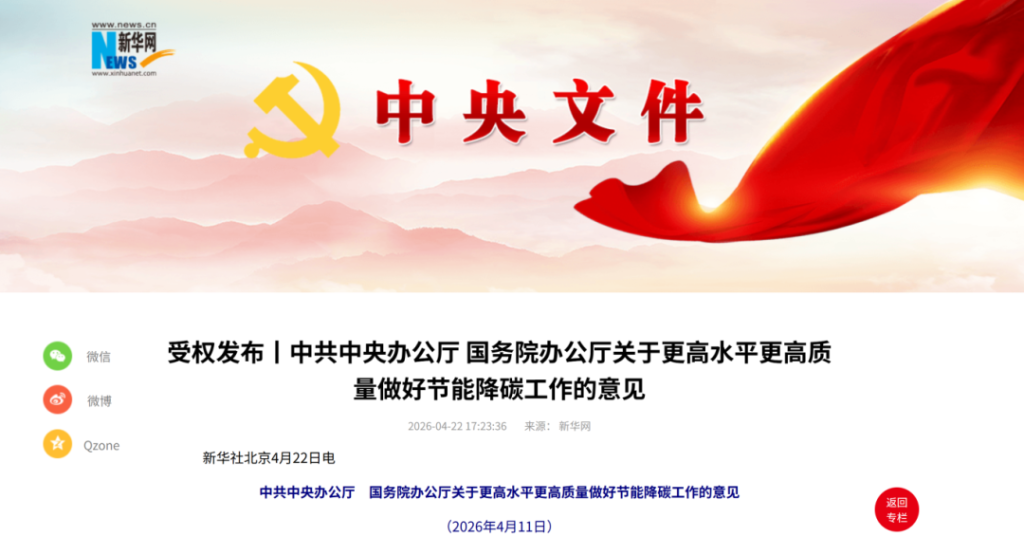
The “Opinions on Performing Energy-Saving and Carbon-Reduction Work with Higher Standards and Quality” was jointly issued by the General Office of the CPC Central Committee and the General Office of the State Council. The document was finalized on April 11, 2026, and officially released to the public on April 22, 2026.
01 Summary of the Core Tenets of the New Policy: Moving Beyond End-of-Pipe Rectification to Comprehensive Source Carbon Control
The core tenet of the new policy is clear and explicit: Adhere to the principle of prioritizing conservation; integrate energy saving and carbon reduction into all aspects and the entire process of economic and social development; perform energy-saving and carbon-reduction work with higher standards and quality; resolutely curb the unreasonable growth of total energy consumption; continuously improve energy and resource output efficiency; effectively reduce carbon emissions from the source; and provide a strong guarantee for achieving carbon peak and carbon neutrality and accelerating the comprehensive green transition of economic and social development.
02 Five Core Key Tasks of the New Policy
1. Collaborative Promotion of Energy Saving, Carbon Reduction, and Green Transition
- Industrial Sector: Retrofit traditional high-energy-consuming industries and develop green, low-carbon emerging industries.
- Energy Sector: Strictly control fossil fuel consumption and ensure all new electricity consumption is covered by clean energy.
- Development Model: Implement the new “using green to produce green” green industry model.
2. Energy-Saving and Carbon-Reduction Campaigns Across Key Sectors
- Industry: Implement energy efficiency retrofits in steel, non-ferrous metals, petrochemicals, chemicals, and building materials, and promote overall carbon reduction in industrial parks.
- Construction: Enforce energy efficiency in new buildings and implement energy-saving retrofits for existing buildings.
- Transportation: Construct zero-carbon transport corridors and promote low-carbon transport vehicles.
- Digital Infrastructure: Implement energy-saving assessments and source control for computing power and data centers.
- Public Institutions: Promote energy consumption quota management and contract energy management.
3. Strengthen the Energy-Saving and Carbon-Reduction Supervision and Management System
- Project Access: Implement carbon emission equivalent or reduced replacement for new, renovated, or expanded projects.
- Enterprise Management: Establish systems for energy consumption and carbon ledgers, annual reporting, and inventory submission.
- Process Supervision: Conduct normalized monitoring, indicator benchmarking, and specialized supervisory law enforcement.
4. Improve the Policy Support and Guarantee System
- Laws and Standards: Revise the Energy Conservation Law, Renewable Energy Law, and industry energy efficiency and carbon emission limits.
- Economic Policies: Implement differentiated electricity pricing, low-carbon transition funds, and green procurement policies.
- Technical Support: Accelerate breakthroughs in low-carbon technologies and the promotion and application of green equipment.
5. Society-wide Low-Carbon Action and International Cooperation
- Promote energy-saving awareness among all citizens and establish social supervision mechanisms.
- Support low-carbon service enterprises in “going global” and promote mutual recognition of international standards.
03 Core Regulations of the New Policy: Three Rigid Constraints on Enterprise Operations
Based on the official interpretation by the National Development and Reform Commission (NDRC) and the detailed policy analysis by People’s Daily, this new policy is no longer a principled call to action but a set of substantive, rigid management clauses. It specifically addresses the shortcomings in energy-saving and carbon-reduction supervision, forming three hard constraints on enterprise production and operations. All production enterprises must pay high attention to these and avoid any sense of complacency.
First, control of project approval at the source; new projects must formulate carbon emission replacement plans. The new policy clarifies core requirements for source control: all new, renovated, or expanded industrial projects with high energy consumption and high emissions must simultaneously formulate equivalent or reduced carbon emission replacement plans. Carbon emission evaluation serves as a core prerequisite for project approval, verification, and filing; high-carbon, low-efficiency projects will be directly vetoed. At the same time, project access control in fields such as industry, construction, and digital infrastructure will be strengthened to strictly control unreasonable energy consumption and new carbon emissions from the entry point, eliminating the expansion of high-carbon, low-efficiency capacity at the root.
Second, mandatory establishment of enterprise ledgers; full-process data supervision and traceability. The policy strictly requires all key energy-using and carbon-emitting units to improve specialized management archives for energy saving and carbon reduction. They must strictly implement the annual energy utilization status report and the normalized carbon emission inventory submission and review system, properly equip energy and carbon emission measuring instruments, and build information management systems. Subsequent supervision will involve normalized monitoring of the entire process, regular tracking and comparison of energy consumption indicators, and regular supervision and inspection by multiple departments. Enterprise energy consumption and carbon data must form a full-process closed loop and be traceable throughout; cases of data fraud or missing ledgers will be directly included in credit punishment mechanisms.
Third, implementation of differentiated electricity pricing; costs for high-carbon enterprises continue to rise. The new policy specifies the improvement of differentiated electricity pricing policies for key industries. Hierarchical management will be implemented based on enterprise energy consumption performance and carbon emission levels; high-energy-consuming and high-emission enterprises will face tiered energy cost surcharges. Simultaneously, the policy vigorously promotes the digital, intelligent, and green technical upgrading of traditional industries, cultivates new green and low-carbon business formats, and promotes the “using green to produce green” development model. Compliant low-carbon enterprises can enjoy benefits such as policy preference, procurement priority, and financial support, while the operational pressure on high-carbon, extensive enterprises continues to increase.
04 Four Compliance Preparations Enterprises Can Make Early
The new policy has officially taken effect, and local territorial supervision work is about to be transmitted and rolled out across all levels. Rather than undergoing passive rectification and spending money on remedies later, enterprises should take the initiative to plan ahead, completing compliance groundwork at a low cost and avoiding operational risks at the root. As a compliance service agency deeply rooted in the “Dual Carbon” field, we provide four tailored, practical suggestions for all production enterprises based on the core requirements of the new policy and authoritative interpretations from the NDRC and People’s Daily:
① Quickly complete a baseline survey of enterprise energy and carbon to clarify your own “energy and carbon account.” In accordance with the accounting requirements of this new policy and the official national unified carbon accounting guidelines, inventory all categories of energy consumption including fossil fuels, electricity, and heat. Complete a full inventory of basic Scope 1 and Scope 2 carbon emissions to accurately understand your annual total energy consumption, total carbon emissions, weak links in high energy consumption, and non-compliance risk points. This ensures you are well-informed and prepared, aligning with the core requirement of source control in the new policy and avoiding a lack of information during subsequent regulatory inspections, which could lead to rushed data compilation at year-end and penalties for violations.
② Build a standardized, integrated ledger for energy saving, carbon reduction, and carbon management as soon as possible. Closely follow the core requirements of the new policy regarding source control and standardized archive management. Completely abandon the extensive management mode of temporarily patching materials and cobbling together data at the end of the year. Establish a normalized, standardized, and specialized integrated ledger for energy saving and carbon emissions. Systematically record core data such as daily and monthly energy consumption, production conditions, operation of emission facilities, and implementation of energy-saving retrofits. Ensure that data is authentic, effective, and logically consistent to meet the requirements of regulatory departments for archive management, data submission, and normalized verification, and to be ready at any time for joint inspections and annual specialized verifications by the NDRC, Ministry of Industry and Information Technology, and Ministry of Ecology and Environment.
③ Complete compliance report preparation on time and ensure normalized filing and coordination. According to the specific time nodes and territorial supervision requirements defined in the new policy, prepare energy-saving and carbon-reduction self-inspection reports and annual enterprise greenhouse gas emission reports on time. Coordinate with third-party compliance verification work as required to successfully complete normalized filing with local competent departments. Review the rigid provisions of compliance audits to build a solid bottom line for enterprise operational safety and completely avoid compliance risks such as deadlines for rectification, public criticism, and enterprise credit punishment.
④ Plan energy-saving and carbon-reduction technical retrofits in advance to seize policy dividends and reduce retrofit costs. Based on the actual energy consumption and carbon emission status of the enterprise, formulate targeted, low-cost optimization and retrofit plans for energy saving and carbon reduction. Phase out inefficient, high-energy-consuming old equipment and optimize the production energy structure to align with the new policy’s core tasks of green technical transformation and energy efficiency improvement for traditional industries. On one hand, this effectively reduces daily energy consumption costs; on the other hand, it allows for active application for specialized energy-saving subsidies, green enterprise ratings, and specialized low-carbon support funds. Seize policy opportunities related to the national low-carbon transition fund to turn passive compliance into proactive quality and efficiency improvement, thereby enjoying the dividends of “Dual Carbon” policies.
Conclusion
The new energy-saving and carbon-reduction policy has clearly established a core tone of full-domain strong supervision and source carbon control. “Dual Carbon” compliance is no longer an optional plan for enterprises but a rigid bottom line for operations. Only by clarifying their carbon baseline in advance, standardizing ledger management, and implementing compliance filing and energy-saving retrofits can enterprises adapt to policy management requirements, avoid risks, seize the dividends of low-carbon transition and development, and achieve long-term stable operations.