-2.png)


Direct Green Power Connection: A Power Line Rewriting Corporate Electricity Bills and Carbon Ledgers
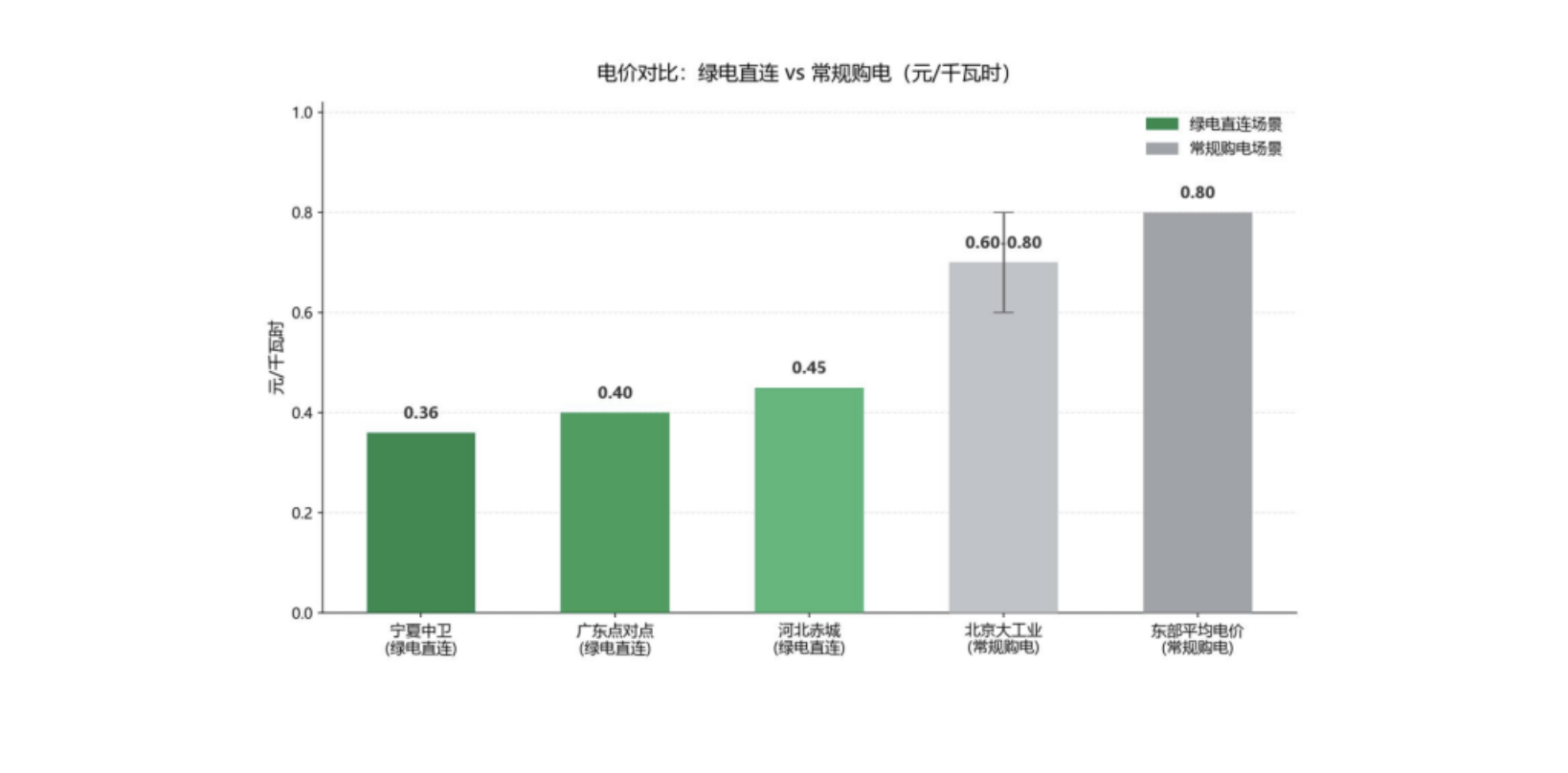
In Zhongwei, Ningxia, a 500,000 kW photovoltaic power station went into operation in May 2026. The electricity it generates does not enter the public grid; instead, it is delivered directly to a data center via a dedicated line. The delivered electricity price is 0.36 RMB/kWh, approximately half of the electricity price in eastern coastal areas. According to public reports, the China Mobile computing power team estimates that this single project can save the enterprise approximately 100 million RMB in electricity costs annually.
This is not an isolated case. In May 2026, the National Development and Reform Commission (NDRC) and the National Energy Administration (NEA) issued the “Notice on Orderly Promoting the Development of Multi-User Direct Green Power Connection” (Fa Gai Neng Yuan [2026] No. 688), expanding direct green power connection from single users to multiple users. Industrial parks and zero-carbon parks can now set up lines to utilize green power.
This article aims to clarify three points: what direct green power connection actually is, how policies have opened up step-by-step, and how enterprises should calculate the accounts—both the cost ledger and the carbon ledger.
01 Clarifying the Concept: What is Direct Green Power Connection?
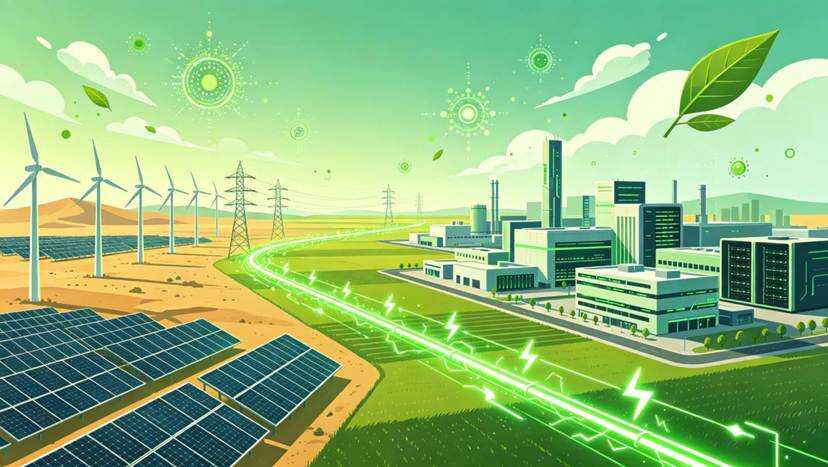
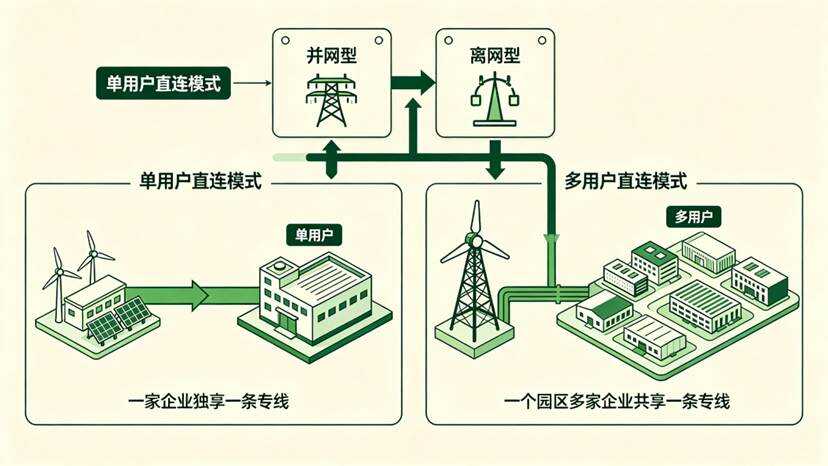
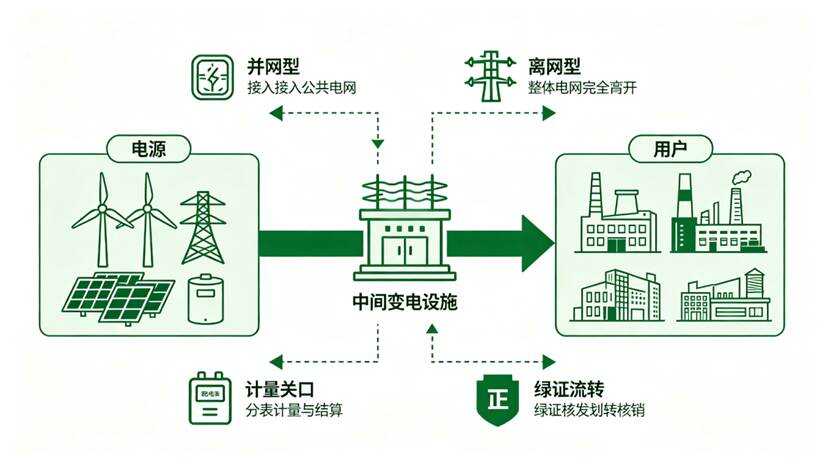
In short: New energy power stations (wind, solar, biomass) bypass the public grid and use a dedicated line and substation facilities to deliver electricity directly to one or more nearby enterprises.
However, it is not equivalent to three things. It is not rooftop distributed PV for self-consumption—which is typically small-scale and covers only a single plant area. It is not green power trading—where electricity still travels through physical grid channels and relies on Green Electricity Certificates (GECs) for certification, whereas direct connection is a physical dedicated line for direct supply. Furthermore, it is not the illegal private installation of power lines—it has a clear policy basis, metering and settlement methods, responsibility interfaces, and safety supervision requirements.
The key to understanding it is transforming the geographical coincidence of a power plant being next door into an institutional arrangement. Document No. 650 of 2025 only allowed a single enterprise to enjoy a dedicated line; Document No. 688 of 2026 expanded this scope to allow multiple different legal entities to share a line (excluding residential and agricultural users), categorized into grid-connected types (integrated into the public grid with clear responsibility interfaces) and off-grid types (completely disconnected from the grid).
02 Policy Evolution: Three Documents Opening a Door
The transition of direct green power connection from breaking the ice to full-scale promotion relied on three key documents.
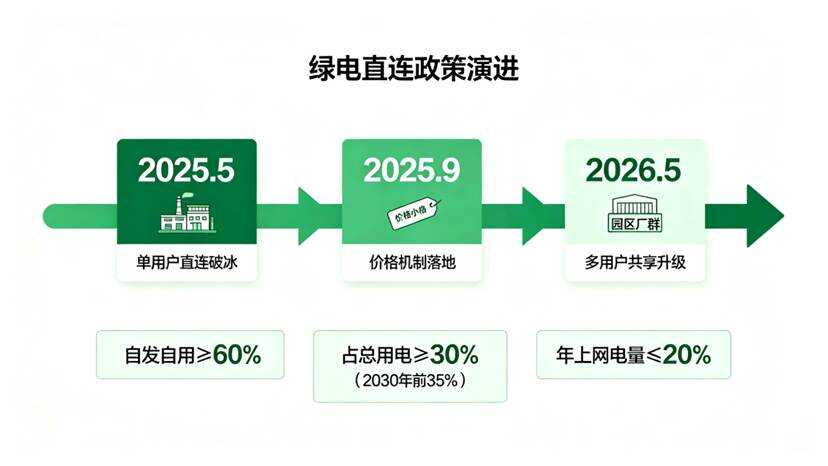
The first, issued in May 2025, is Fa Gai Neng Yuan [2025] No. 650, “Notice on Orderly Promoting the Development of Direct Green Power Connection.” This was the first top-level domestic document for direct green power connection, allowing new energy power stations to pull dedicated lines to supply a single enterprise. It established two hard rules: first, load-based source determination—the annual self-consumption volume must account for no less than 60% of the total available generation and no less than 30% of the total electricity consumption, meaning the load must exist before the power source is allocated; second, projects must not have electricity purchased by grid enterprises as agents, and they must reasonably pay transmission and distribution fees, system operation fees, policy-based cross-subsidies, and government funds and surcharges.
The second, issued in September 2025, is Fa Gai Jia Ge [2025] No. 1192, “Notice on Improving Price Mechanisms to Promote Local Consumption of New Energy Power Generation.” It clarified the accounting: local consumption projects pay transmission and distribution fees based on capacity (demand), and grid-drawn electricity no longer incurs system standby fees or transmission/distribution volume-based electricity charges. Costs for ensuring stable supply are borne fairly according to the principle of “whoever benefits, bears the burden”—making the cost structure of direct connection projects predictable.
The third, issued in May 2026, is Fa Gai Neng Yuan [2026] No. 688, “Notice on Orderly Promoting the Development of Multi-User Direct Green Power Connection.” Direct green power connection was upgraded from single-user to multi-user: all or part of the load in industrial parks, zero-carbon parks, and incremental distribution networks can access new energy locally. Enterprises with green power consumption needs (including key energy-using and carbon-emitting enterprises, and export-oriented enterprises with decarbonization needs) can carry this out as a group. Priority support is given to emerging industries such as computing power facilities and green hydrogen, ammonia, and alcohol. Furthermore, a closed loop for hour-level green power traceability and GEC issuance, transfer, and cancellation has been established.
The logic of these three documents follows a single line: first solving whether it can be built (Document 650), then solving how to calculate the money (Document 1192), and finally solving how to certify green power and who can use it together (Document 688).
03 Mechanism Breakdown: How a Dedicated Line Operates
To understand direct green power connection, one does not need to memorize many technical terms; remembering four stages is sufficient.
Who does it? The project must have a primary responsible entity, which in principle is a joint venture between the power source party and the load party, or can be invested in by one party alone. The park model can be established by the park management committee or a third-party institution (excluding public grid enterprises). Dedicated lines, substation facilities, energy storage, and operation platforms are, in principle, invested in and constructed by the primary responsible entity—this represents the first major investment in direct green power connection.
How is electricity calculated? Load-based source determination is the general principle: a confirmed electricity load must exist before supporting new energy power sources are built. There are three mandatory ratios: annual self-consumption must be no less than 60% of total available generation; it must be no less than 30% of total electricity consumption (increasing to 35% by 2030); and for grid-connected projects, the annual grid-fed electricity volume should, in principle, not exceed 20% of total available generation. Simply put, the policy requires projects to consume most of the electricity themselves rather than reselling it to the grid under the guise of direct connection.
How are fees charged? Grid-connected projects must fairly bear transmission and distribution fees, system operation fees, and policy-based cross-subsidies, and pay government funds and surcharges according to regulations. However, after paying transmission and distribution fees based on capacity, grid-drawn electricity no longer incurs system standby fees or transmission/distribution volume-based charges. Projects must not have electricity purchased by grid enterprises as agents; they participate in the electricity market as a whole, initially entering the electricity spot market by reporting volume without bidding prices.
How is it traced? Internal sub-metering is used within the project, and the self-consumption volume for each user is determined based on the proportion of electricity consumption in each time period, achieving hour-level matching between new energy generation and consumption. GECs are issued, transferred, and cancelled based on the self-consumption volume. This means every kilowatt-hour of direct green power used by an enterprise can be traced back to a specific generation time and unit.
04 The Cost Ledger: How Much Can Enterprises Actually Save?
The cost-saving logic of direct connection is an aggregation of four factors: the levelized cost of energy (LCOE) for new energy is already lower than that of coal power; local direct supply eliminates long-distance transmission and distribution stages; paying transmission and distribution fees based on capacity means the higher the consumption, the lower the unit allocation; and bypassing grid agency purchasing removes a layer of middleman markups. However, the amount saved depends on the actual project.
Several disclosed cases can serve as benchmarks:
Zhongwei, Ningxia, Datang 500,000 kW Photovoltaic-Computing Synergy Project (commissioned May 2026): The direct green power price to the doorstep is 0.36 RMB/kWh, approximately 45% of the average electricity price in eastern coastal areas, with estimated annual savings of about 100 million RMB according to public reports.
Guangdong’s first inter-provincial point-to-point green power transaction (May 2026): 9 data centers purchased 17.45 million kWh of green power at a landed price of approximately 0.40 RMB/kWh, nearly 0.13 RMB cheaper per unit than similar transactions within the province.
Qingyang Computing-Electricity Synergy Park, Gansu: 55% of the park’s electricity is supplied directly by local wind and solar. From January to May 2026, it saved resident enterprises over 13 million RMB in electricity costs, with the annual cost reduction expected to exceed 30 million RMB.
Chicheng Computing Power Base, Hebei: The estimated comprehensive electricity price can be controlled below 0.45 RMB/kWh, with long-term potential to drop to 0.39–0.43 RMB, whereas large industrial electricity prices in Beijing’s core areas range from 0.6 to 0.8 RMB.
Xinjiang Shenhuo Coal & Power Electrolytic Aluminum Workshop: Electricity costs account for over 30% of electrolytic aluminum costs. Stable direct green power supply directly lowers comprehensive electricity costs, allowing green aluminum products to gain a premium in international markets.
However, a reminder: the cost-saving account cannot only calculate the electricity price. Dedicated lines, substation facilities, and energy storage are significant capital expenditures; transmission and distribution fees, system operation fees, and cross-subsidies remain mandatory. The load curve must match the power source output; otherwise, electricity will either be curtailed or supplementary purchases will be required. The cost ledger must be calculated over the project’s entire life cycle.
05 The Carbon Ledger: How Direct Green Power Connection Affects Energy Saving and Decarbonization
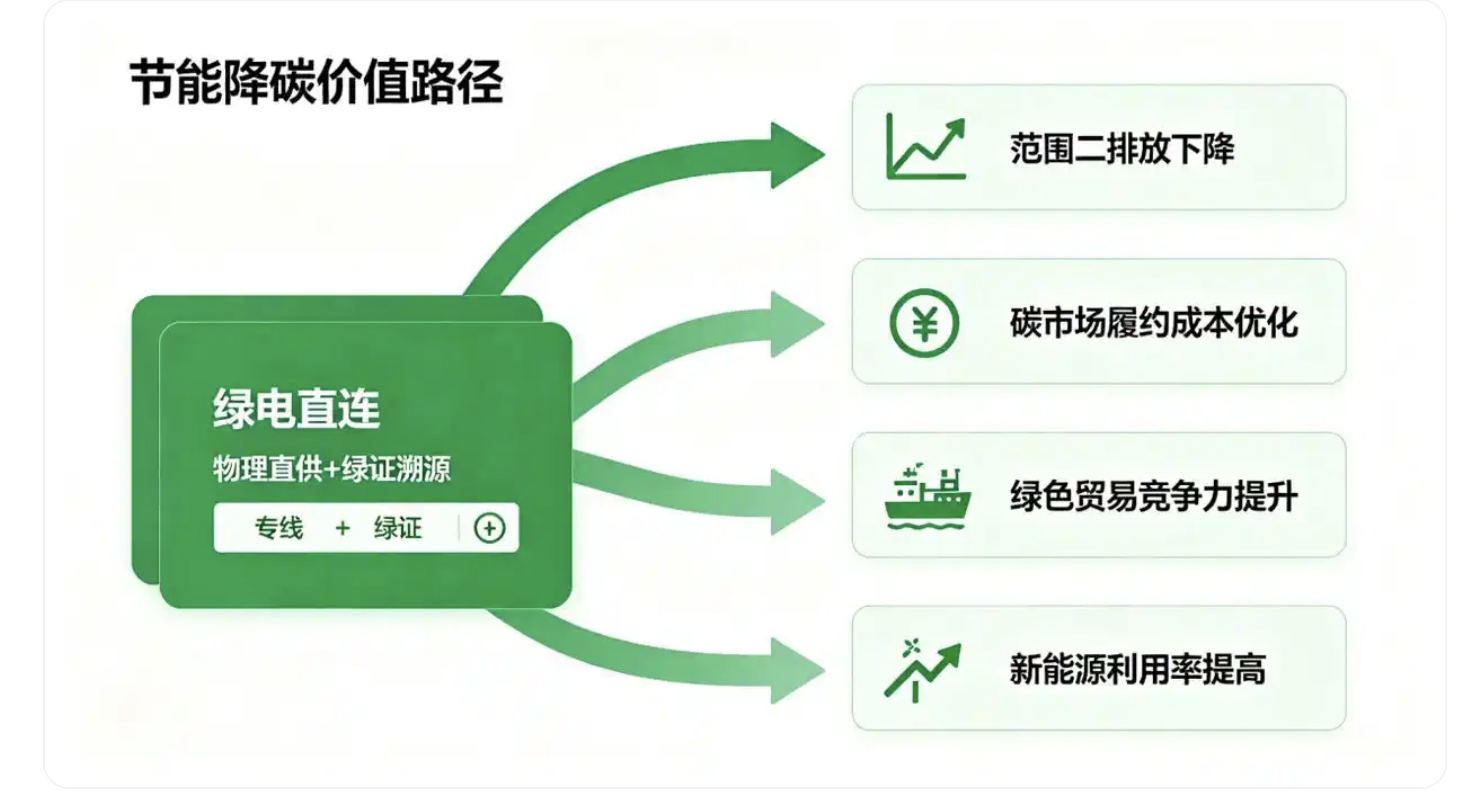
If the cost ledger determines whether to do it, the carbon ledger determines if it is worth it after implementation. The significance of direct green power connection for energy saving and decarbonization can be broken down into four lines.
First, Scope 2 emissions can be zeroed out. Indirect emissions from purchased electricity (Scope 2) represent the bulk of carbon emissions for many manufacturing enterprises. Direct green power is physically supplied by new energy, and combined with hour-level traceability, the carbon emission accounting for corporate electricity use can clearly decrease, even approaching zero.
Second, it provides a lever for carbon accounting and carbon markets. For key emission units included in national or local carbon markets, the accounting of indirect electricity emissions is the basis for compliance. Direct connection projects come with sub-metering and a GEC closed loop, making data auditable and traceable, avoiding disputes over the difficulty of tracing purchased green power certificates.
Third, it addresses international green trade barriers. The entities specifically supported by Document 688 are export-oriented enterprises and their upstream/downstream partners with decarbonization needs. The EU Carbon Border Adjustment Mechanism (CBAM), the Battery Regulation, the RE100 initiative, and Science Based Targets (SBTi) are all increasing requirements for green power consumption ratios and traceability. Physical direct supply + GECs is currently the most robust proof of green electricity.
Fourth, it improves new energy utilization efficiency. Direct connection projects require energy storage and source-load coordinated regulation. Curtailed new energy is not included in utilization rate statistics, converting wind and solar power that might otherwise be wasted into corporate output value locally, while reducing peak-shaving pressure on the public grid.
06 Three Common Misconceptions to Eliminate First
Misconception 1: Direct green power connection equals zero-cost electricity. This statement is incorrect as it only looks at the cheap electricity price and ignores the complete bill. Direct connection projects must bear transmission and distribution fees, system operation fees, and policy-based cross-subsidies, and pay government funds and surcharges; they also require investment in dedicated lines, substation facilities, and energy storage. What is saved are the intermediate stages and market-based price differences, not the cost of electricity itself.
Misconception 2: Direct green power connection is just pulling a wire yourself. Pulling a wire is only the surface; compliance is the core. Projects must be included in provincial new energy power generation development and construction plans, a primary responsible entity must be established, bidirectional time-of-use metering devices must be installed, unified dispatch management must be accepted, and safety responsibilities must be clarified and reported. Bypassing metering devices to use electricity is a strictly prohibited illegal and non-compliant act.
Misconception 3: Having GECs is enough; direct connection is unnecessary. GECs solve the certification of environmental attributes, while direct connection solves physical power supply and cost reduction; the two are not substitutes. Direct connection projects come with GEC issuance while adding the dual effects of cost savings and traceability. For industries sensitive to electricity costs and carbon accounts, the attraction of direct connection is significantly greater.
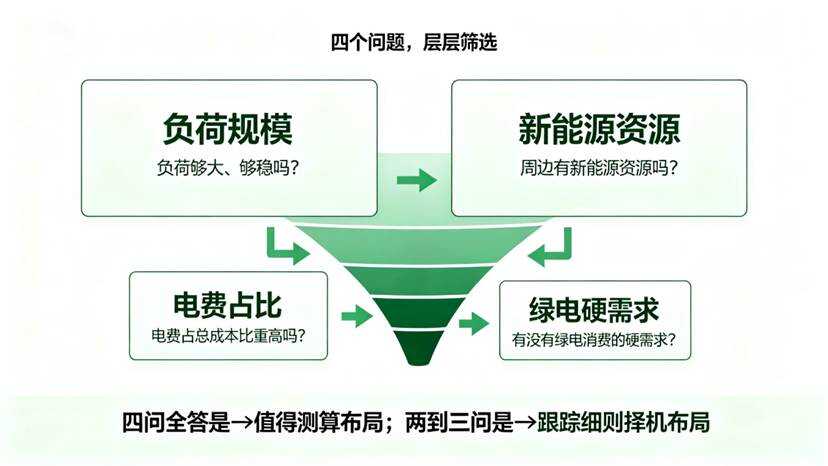
07 Decision Framework: Four Questions for Enterprises Considering Adoption
Question 1: Is the load large and stable enough? The red line for the self-consumption ratio is clear (no less than 30% of total electricity consumption, 35% by 2030). For projects where the electricity consumption curve and power source output do not match, the economic account will be very poor due to either curtailed electricity or the need to spend more on purchasing power.
Question 2: Are there new energy resources nearby? The core of direct connection is proximity. The endowment of wind and solar resources, available land, and grid connection conditions determine whether the project has a physical foundation.
Question 3: Does the electricity cost account for a high proportion of total costs? Electricity costs for data centers account for about 60% to 70% of total operating costs, and over 30% for electrolytic aluminum—the higher the proportion, the greater the cost-reduction elasticity of direct connection.
Question 4: Is there a hard demand for green power consumption? Export certification, carbon market compliance, ESG ratings, and major customer supply chain requirements will all transform green power from a bonus into a necessity.
If the answer to all four questions is yes, it is worth conducting serious calculations and preliminary demonstrations. If two to three are yes, you can track provincial implementation rules and plan for an opportune time. If none apply, it is not too late to wait and see.
08 Boundaries and Observation Points
What is certain currently is that policy has paved the way: from single-user to multi-user, and from whether it can be built to how to calculate costs and certify green power, an institutional framework is in place. However, actual implementation depends on several factors: provincial implementation rules (how proximity distance, grid-fed electricity ratios, and exit mechanisms are refined), the actual efficiency of grid connection, the investment return cycle for dedicated lines, and the pricing of direct connection projects by the electricity spot market.
Conclusion
For most enterprises, direct green power connection is not a model that can be used tomorrow, but an option worth including in a three-to-five-year energy strategic plan. It saves money, accounts for carbon, and bets on the direction of new energy consumption and electricity marketization reforms.
When a kilowatt-hour of electricity can save money, reduce carbon, and become a green pass for exports, an enterprise’s energy choice is no longer just a procurement issue, but a strategic one.