-2.png)


On July 9, 2026, the State Council officially issued the “15th Five-Year Plan” Carbon Peaking Action Plan (Guo Fa [2026] No. 22), clarifying that the “15th Five-Year Plan” period is the critical period for China to achieve carbon peaking. With green and low-carbon energy transition as the core focus, it coordinates energy security with economic and social development, drawing a clear five-year construction map for achieving carbon peaking as scheduled before 2030.
For practitioners in the dual carbon field, this document is both a rigid basis for policy execution and a core guide for business layout. This article deconstructs the plan from three dimensions: core positioning, key tasks, and implementation actions, helping practitioners quickly understand the policy and identify their own direction.
I. Core Positioning and Quantitative Goals of the Plan: Rigid Benchmarks for the Carbon Peaking Battle
This plan is a deepening of the top-level framework of the “Action Plan for Carbon Peaking Before 2030.” Its core positioning is “driving industrial upgrading through carbon reduction and ensuring the pace of transformation through security.” It no longer simply emphasizes the speed of carbon reduction but balances development and security, promoting the steady peaking of coal and oil consumption, and integrating green and low-carbon orientation into all sectors of the national economy.
First, understand: What is different this time?
Qualitative summary in one sentence: A comprehensive shift from “top-level design” to “implementation and execution.”
Core logic: Driving industrial upgrading through carbon reduction, ensuring the pace of transformation through security.
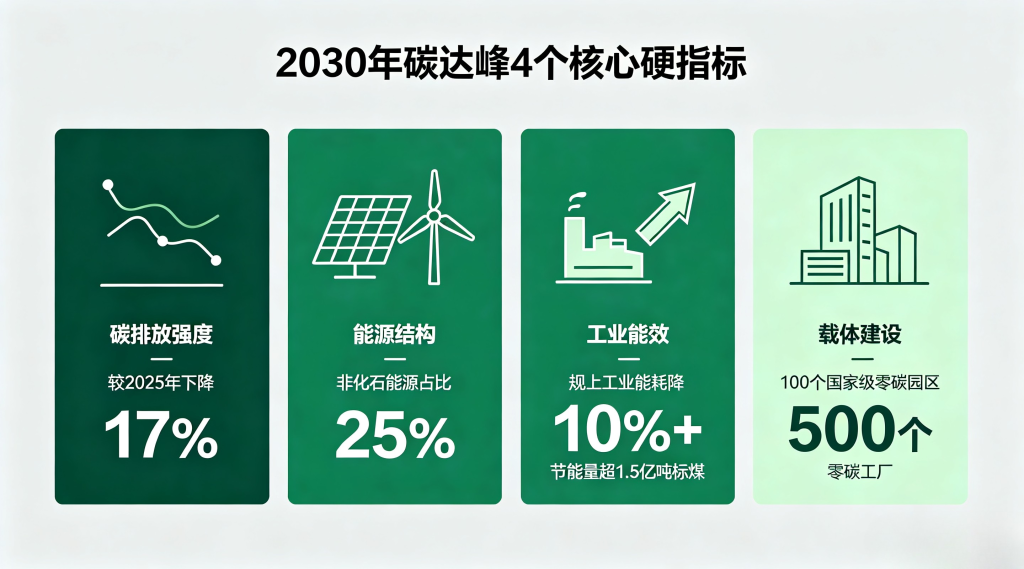
4 “Hard Indicators” you must watch closely (2030 goals):
- Carbon emission intensity: A 17% decrease compared to 2025 (this is a rigid requirement).
- Energy structure: Non-fossil energy accounts for 25%, and coal and oil consumption must peak steadily.
- Industrial energy efficiency: Energy consumption per unit of added value for industrial enterprises above designated size will drop by more than 10%, with energy savings exceeding 150 million tons of standard coal.
- Carrier construction: Completion of 100 national-level zero-carbon parks and 500 zero-carbon factories (this is a huge market cake).
II. Deconstruction of Five Key Tasks: A Comprehensive Review of Policy Dividends and Business Directions
The plan deploys tasks in five major directions: energy, industry, key areas, support and guarantees, and joint efforts. Among them, three areas have the highest business relevance for dual carbon practitioners and are the core tracks where policy resources will be concentrated in the next five years. Although the plan is long, money and talent will mainly flow in these three directions:
1. Energy Structure Adjustment: From “Incremental Substitution” to “System Adaptation”
Energy transition is the core focus of carbon peaking. This plan no longer only emphasizes the scale of new energy installation but focuses on “consumption and integration capacity” and “substitution pace”:
- Supply side: Simultaneous development of wind, solar, hydro, and nuclear power, vigorously promoting the development of non-fossil energy. Large-scale wind and solar bases, distributed energy, nuclear power, and pumped storage will continue to maintain construction momentum.
- System side: Focus on improving the new energy consumption capacity of the power system. New business formats such as industrial green microgrids, source-grid-load-storage integration, virtual power plants, and demand response will receive strong policy support.
- Substitution side: Deeply promote the clean substitution of coal consumption, with coal power gradually transforming into a fundamental regulating power source; oil and gas consumption will focus on conservation and efficiency, with hydrogen refueling stations and integrated energy stations becoming the direction for oil and gas terminal transformation.
- Market side: Expansion of green power direct connection policies, encouraging zero-carbon parks and eligible industrial enterprises to directly connect with new energy projects. Green power and green certificate procurement will gradually change from an “extra credit item” to a “rigid requirement.”
2. Industrial Low-Carbon Transformation: Simultaneous Efforts in Stock Transformation and Incremental Tracks
Industrial carbon reduction is the core business scenario for dual carbon practitioners. Based on the stock transformation of traditional industries, this plan adds two incremental tracks while continuing to strengthen the bottom line of source control, forming a three-line parallel pattern of “stock efficiency improvement + incremental breakthrough + rigid constraints”:
- Deep transformation of traditional high-energy-consuming industries: For the five major industries of steel, electrolytic aluminum, cement, flat glass, and petrochemical chemicals, comprehensively implement energy-saving and carbon-reduction transformations, promote low-carbon processes, waste heat and pressure recovery, and energy-efficient equipment upgrades, supported by energy-saving supervision and energy-efficiency diagnosis mechanisms. Phasing out backward capacity and substituting low-carbon processes will become the main theme.
- Batch implementation of zero-carbon parks and zero-carbon factories: For the first time, quantitative construction goals are clarified, pushing carbon reduction management units down from “industries” to specific parks and enterprises. Through models such as green power direct connection, low-carbon heating, and park carbon management platforms, a “green-to-green” industrial cluster will be created.
- Green and low-carbon transformation of computing power facilities: Included in the national-level carbon peaking core tasks for the first time, requiring the coordinated layout of computing power facilities and renewable energy. New computing power facilities should prioritize the use of non-fossil energy, and stock projects should promote energy-efficiency transformation. Green computing power and computing-power-electricity coordination will become a brand-new business track.
- Strict control of “Two Highs” projects: Continue to strengthen source control. New, renovated, or expanded “Two Highs” (short for high energy consumption and high emission) industrial projects must implement equal or reduced carbon emission replacement. Capacity control and carbon review will remain rigid.
3. Support and Guarantee System: Explosion of Demand for Market-Oriented Services and Professional Capabilities
The plan clarifies the supporting system for carbon peaking, directly generating a large amount of demand for professional services:
- Continuous improvement of the carbon emission statistics and accounting system: Carbon accounting standards at the enterprise, park, and product levels will be gradually improved, and the demand for accounting, verification, and inventory business will continue to grow.
- Deepening of market-oriented mechanisms: The coverage of the national carbon market will gradually expand, and third-party governance models such as green power, green certificates, carbon inclusion, energy performance contracting, and carbon custody will accelerate their promotion.
- Upgrade of standards and certification systems: Certification and evaluation systems for zero-carbon factories, zero-carbon parks, green products, and low-carbon technologies will be gradually established, with broad space for corresponding consulting, coaching, and certification businesses.
- Strengthening of technology and talent support: Low-carbon technology R&D and carbon management professional talent training will receive policy support, with the threshold and value of professional services in the industry rising simultaneously.
III. Action Guide for Dual Carbon Practitioners: Which Category Are You? Find Your Place!
Understanding policy must ultimately translate into business actions. For dual carbon practitioners in different positions and fields, near-term and medium-to-long-term actions can be planned according to the following directions:
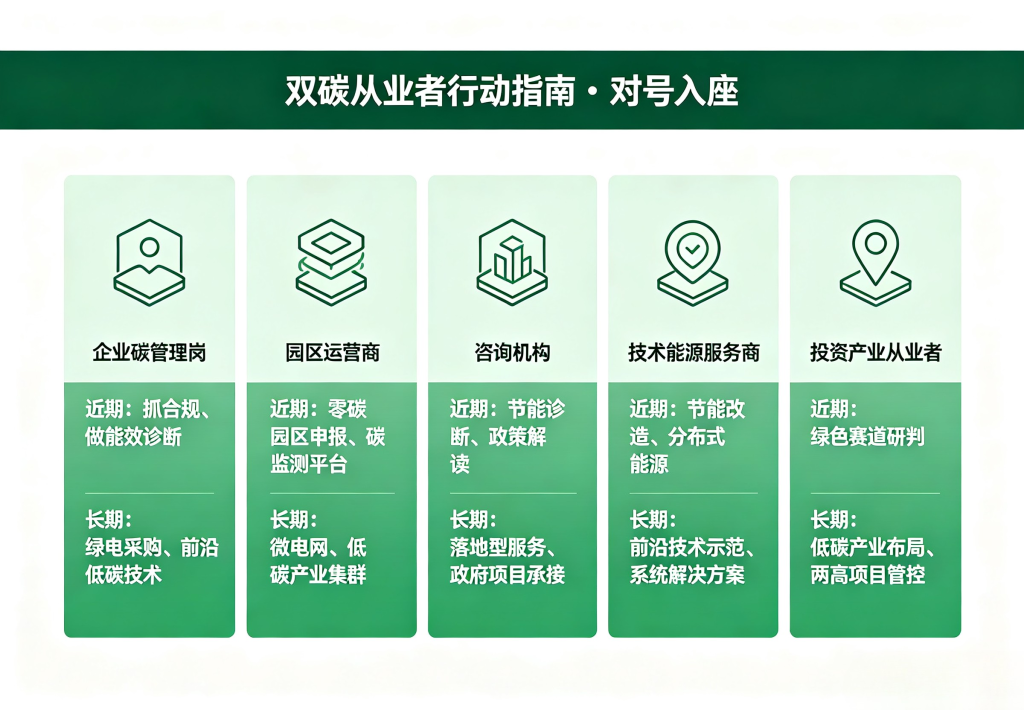
1. Corporate Carbon Management Position: Focus on compliance first, then seek efficiency
This year (2026): Conduct energy efficiency diagnosis immediately to understand the current status; check the compliance of “Two Highs” projects to avoid crossing red lines.
Future: Plan green power procurement, and implement green power direct connection where conditions permit; layout hydrogen metallurgy and Carbon Capture, Utilization, and Storage (CCUS) in advance to cope with rising carbon costs.
2. Park Operators:
This year: Prepare to apply for zero-carbon parks according to national standards; set up energy management and carbon monitoring platforms.
Future: Build microgrids, install photovoltaics, and configure energy storage; attract low-carbon industries to create a circular economy chain.
3. Consulting Agencies:
Transformation: From a “writer” of reports to an “operator” who can implement projects. Focus on energy-saving diagnosis, zero-carbon park coaching, and carbon management system construction.
Expansion: Visit Development and Reform Commissions and Industry and Information Technology departments more often to undertake government research topics and diagnosis projects.
4. Technology/Energy Service Providers:
Opportunities: Distributed photovoltaics, energy storage, industrial kiln transformation, waste heat recovery.
Layout: Keep an eye on the national key project database and engage in the demonstration application of cutting-edge technologies such as CCUS and hydrogen energy.
5. Investors/Industry Practitioners:
Focus on: Green energy equipment, green computing power, carbon management services, bio-based materials.
Avoid: New “Two Highs” capacity that does not meet energy efficiency benchmarks.
IV. Implementation Pace Tips: Grasp Key Time Nodes
- 2026: Provinces will successively issue local carbon peaking action plans, clarifying annual decomposed targets and supporting policies; annual carbon peaking assessments will officially start, and compliance requirements will be implemented first.
- 2027-2029: Energy-saving and carbon-reduction transformation in key industries will enter a peak period, and zero-carbon parks and zero-carbon factories will enter the stage of batch construction and acceptance; coal and oil consumption will peak successively, and new energy and market-oriented mechanisms will be fully deepened.
- 2030: Comprehensive acceptance of the completion of carbon peaking goals, and the policy system will smoothly transition to the carbon neutrality stage.
Overall, the “15th Five-Year Plan” Carbon Peaking Action Plan marks a comprehensive shift in China’s carbon peaking work from “top-level design” to “implementation and execution,” and the policy orientation has changed from “concept popularization” to “rigid assessment + scenario implementation.” For dual carbon practitioners, following the policy pace, focusing on physical scenarios, and deepening professional capabilities are not only inevitable choices to meet policy requirements but also core paths to seize the dividends of green transformation.