-2.png)


I. Policy Background
This policy is based on the “Three-Year Action Plan for Energy Saving and Carbon Reduction Transformation in Key Industries (2026-2028)” (NDRC Huan Zi [2026] No. 698) issued by five departments. It covers nine high-energy-consuming industries: steel, electrolytic aluminum, cement, flat glass, oil refining, ethylene, synthetic ammonia, methanol, and coal-fired power. The policy explicitly requires that production capacity below the energy efficiency baseline level be basically eliminated by the end of 2028, achieving a cumulative energy saving of over 100 million tons of standard coal and a reduction of over 200 million tons of carbon dioxide over three years. As a business leader, completing energy-saving technical transformations on schedule allows you to enjoy policy subsidies and avoid heavy penalties.
II. Self-Inspection and Elimination of Obsolete Equipment and Capacity (All rectifications to be completed by 2028)
1. Unified Upgrade of General Plant Equipment
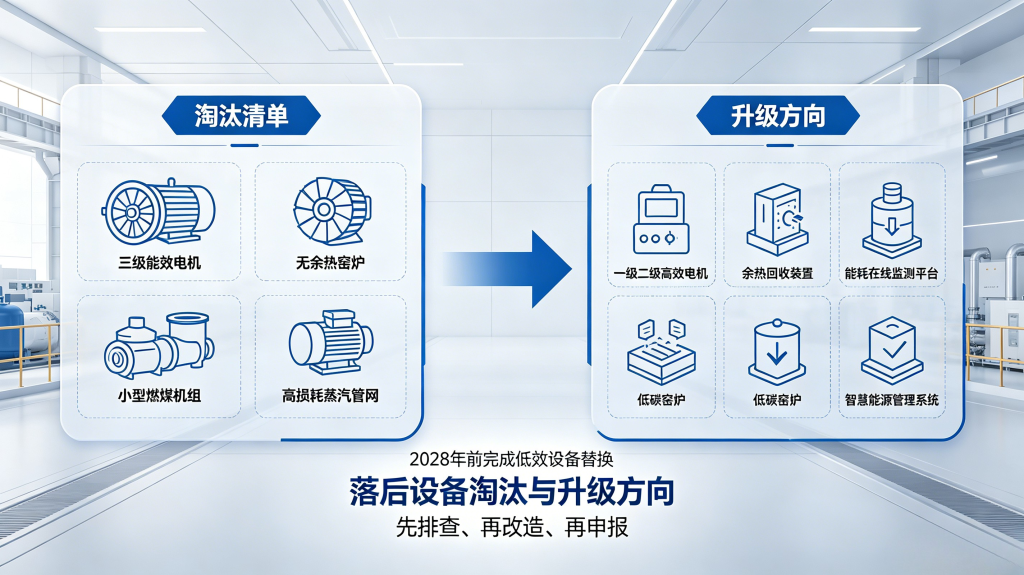
1) Eliminate Grade 3 and below motors, fans, water pumps, air compressors, and transformers, and replace them with Grade 1/2 high-efficiency energy-saving equipment;
2) Shut down or technically transform small self-provided coal-fired units, kilns without waste heat recovery, and high-loss steam pipe networks;
3) Build an online energy consumption monitoring system and improve energy and carbon emission ledgers; failure to rectify within the deadline will result in restrictions.
2. Deadline for Phasing Out Obsolete Capacity by Industry
Steel: Eliminate top-charging coke ovens under 6 meters, tamping coke ovens under 5.5 meters, blast furnaces under 1200m³, converters under 100 tons, and alloy steel electric arc furnaces under 50 tons; equip with dry quenching, and promote gas recovery, hot charging and hot delivery, and short-process steelmaking.
Electrolytic Aluminum: Upgrade electrolytic cells of 300kA and below to large energy-saving cells of 500kA and above.
Cement: Completely shut down old-style shaft kilns; transform clinker lines under 2000 tons/day and grinding stations under 600,000 tons/year within a time limit; equip all clinker lines with waste heat power generation and low-nitrogen combustion devices.
Flat Glass: Transform inefficient float kilns and production lines without flue gas waste heat recovery, and promote oxy-fuel combustion.
Coal Chemical Industry: Eliminate atmospheric and vacuum distillation, small-scale cracking, and intermittent gasification units under 10 million tons/year; perform system energy optimization and waste heat recovery.
Coal-fired Power: Prioritize shutting down inefficient pure condensing units under 300,000 kW; if supply must be guaranteed, short-term flexibility transformation can be implemented; fully upgrade units above 300,000 kW for energy saving and peak shaving.
Mandatory Requirement: If the energy efficiency of a production line still fails to reach the industry baseline by the end of 2028, the corresponding capacity will be shut down according to law; enterprises whose energy efficiency reaches the industry benchmark can enjoy policy dividends such as financial subsidies, electricity price discounts, and preferential energy consumption quotas.
III. Full Process for Enterprise Project Application (Leaders to coordinate and assign dedicated personnel for implementation)
(I) Application Process for Central Budgetary Energy-Saving Subsidies
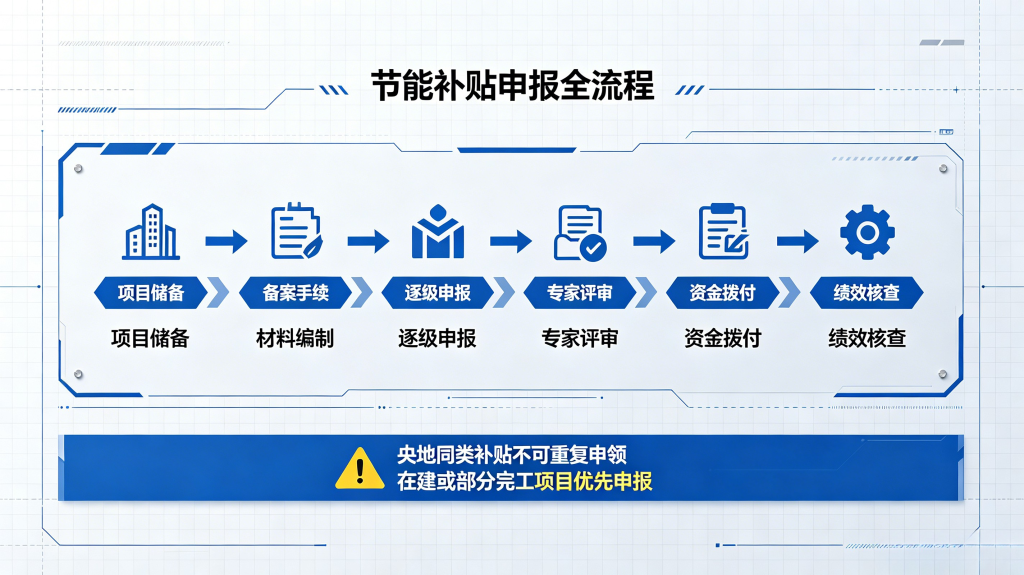
1. Preliminary Preparation: Identify eligible technical transformation projects and complete procedures such as project filing, energy assessment, and environmental impact assessment; only projects under construction or partially completed can apply; fully completed projects will not be accepted; calculate energy savings and prepare proof of funds.
2. Material Preparation: Fund application report, business license, audit report, equipment contracts, certificate of no record of untrustworthiness, and various approval documents.
3. Step-by-Step Application: Fill in the National Major Project Database online; report level by level from district/county → municipal → provincial; central enterprise groups report directly to the state.
4. Review and Implementation: Third-party technical review; energy-saving projects can receive a maximum subsidy of 20% of the total investment; after funds are issued, construct according to the plan, followed by completion acceptance and performance evaluation, with supervision throughout the process.
(II) Application Process for Provincial and Municipal Energy-Saving Special Funds
1. Project Screening: Provincial and municipal subsidies can be stacked, but projects that have received central subsidies cannot apply again; most regions require equipment to have operated stably for more than 3 months.
2. Online and Offline Application: Upload transformation contracts, invoices, third-party energy saving audit reports, and a commitment letter of no duplicate fund applications.
3. Joint Review: Industry and Information Technology Bureau + Finance Bureau conduct on-site equipment verification, and expert review determines a subsidy ratio of 5%-15%.
4. Publicity and Disbursement: Funds are disbursed after 5 working days of public notice; enterprises must retain transformation ledgers for 3 years for inspection.
IV. Carbon Asset Value-Added Operations (Leaders to plan ahead for extra income and compliant fulfillment)
1. Emission Reduction Quota Replacement: Emission reductions from technical transformations, verified and filed by a third party, can be used for carbon emission replacement in new “Two Highs” projects, and surplus quotas can be sold for cash.
2. Carbon Allowance Revenue: If carbon emission intensity is better than the industry benchmark, enterprises can obtain preferential free allowances and sell excess allowances in the carbon market; enterprises with lagging energy efficiency must buy allowances at high prices to fulfill their obligations.
3. Green Electricity and Green Certificate Offsets: Use on-site photovoltaic green certificates and direct-purchase green electricity to complete renewable energy assessments and address the EU’s CBAM carbon border tax.
V. Must Be Vigilant: Heavy Penalties for Non-Compliance (Core risk points for managers)
1. Punitive Electricity Prices: If energy efficiency is below the industry baseline, the price per kWh can be increased by up to 0.1 yuan; the surcharge can only be canceled once the transformation meets the standard.
2. Multiple Administrative Sanctions
① A 6-month rectification period is issued; if overdue, production will be suspended and obsolete capacity shut down;
② Energy-saving reviews for new projects will be stopped, and no new energy consumption quotas will be allocated;
③ Inclusion in the energy-saving untrustworthiness list, canceling all subsidies, tax incentives, and green loans;
④ Failure to complete annual energy-saving targets will lead to interviews with corporate leaders and the implementation of capacity control.
3. Carbon Market Compliance Fines
If carbon allowance gaps are not cleared on time, in addition to making up the allowances, a fine of 5-10 times the carbon price will be imposed; refusal to rectify will result in an equivalent reduction of the next year’s allowance, and serious cases will be ordered to stop production.
VI. 4-Step Action Plan for Corporate Leaders to Implement
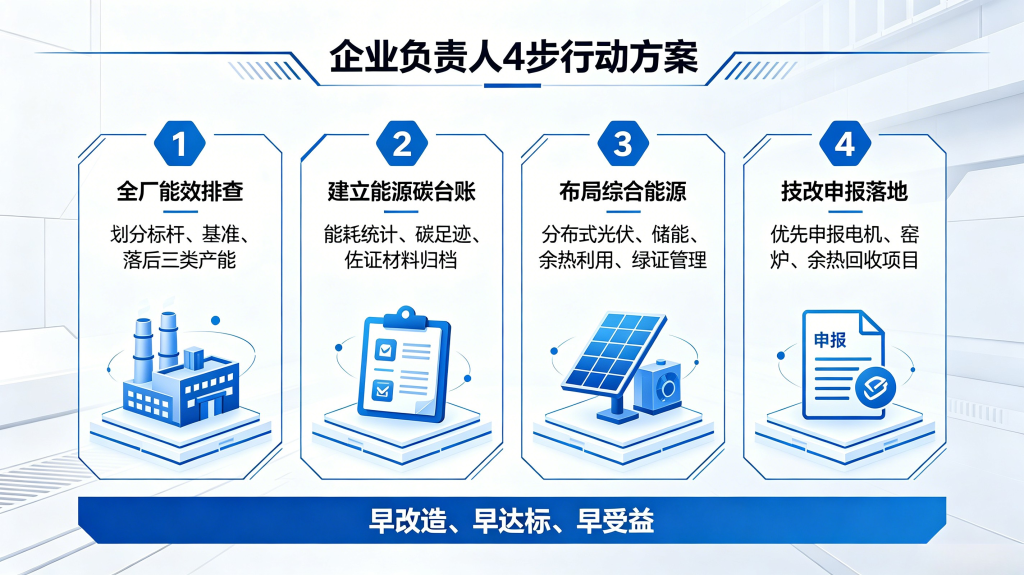
1. Step 1: Comprehensive Plant-wide Energy Efficiency Audit
Classify capacity into benchmark, baseline, and lagging categories; prioritize the transformation of motors, kilns, and waste heat recovery to seize the three-year subsidy window.
2. Step 2: Improve Energy and Carbon Management Systems
Establish energy consumption ledgers and carbon footprint accounting to prepare materials in advance for subsidy applications, carbon compliance, and low-carbon export compliance.
3. Step 3: Plan Integrated Energy Projects
Simultaneously build distributed photovoltaics and energy storage to reduce electricity costs, obtain green certificates, and participate in virtual power plants for additional income.
4. Step 4: Implement Technical Transformations Early, No Procrastination
2026-2028 is the critical window; the later the transformation, the greater the pressure from electricity price penalties and application competition, and the higher the overall cost.