-2.png)


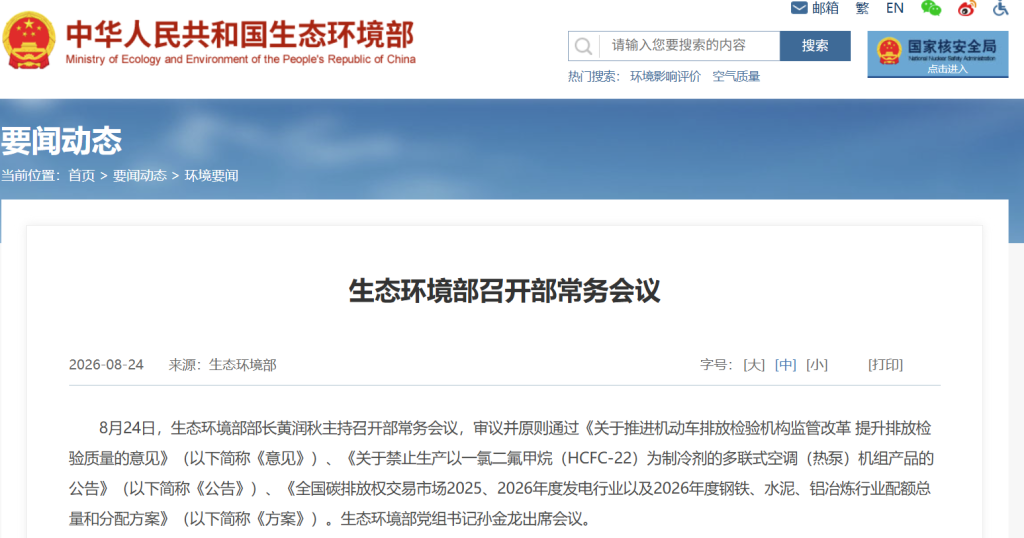
On August 24, the Ministry of Ecology and Environment held an executive meeting to review and approve in principle the “Total Quota and Allocation Plan for the Power Generation Industry for 2025 and 2026, and for the Steel, Cement, and Aluminum Smelting Industries for 2026” (hereinafter referred to as the “Plan”). This document is a significant institutional arrangement for quota management in the power, steel, cement, and aluminum smelting sectors following the expansion of the national carbon market. It also marks the national carbon market’s progression from industry inclusion and rule adaptation toward further quota constraints and refined management.
According to the explanation previously released by the Ministry of Ecology and Environment for public comment, the primary purpose of the “Plan” is to effectively carry out quota allocation for the power, steel, cement, and aluminum smelting industries, further leveraging market mechanisms to control greenhouse gas emissions and reduce the overall cost of emission reductions for society. The draft for comments was released in July, with the feedback deadline set for August 5.
Regarding coverage, the “Plan” simultaneously involves the power generation industry for 2025 and 2026, as well as the steel, cement, and aluminum smelting industries for 2026. This means that the power generation industry remains the foundational sector of the national carbon market, while the steel, cement, and aluminum smelting industries enter a more substantial stage of quota allocation following the expansion. Previous work plans have clarified that key emission units in the steel, cement, and aluminum smelting industries must surrender carbon emission quotas in full to provincial ecological and environmental authorities annually and conduct centralized unified trading through the national carbon emission rights trading system.
Regarding allocation methodology, the steel, cement, and aluminum smelting industries will implement quota allocation primarily based on carbon emission intensity control during the initial implementation phase. Public documents show that the 2024 quota allocation will equal the verified actual carbon emissions, while the 2025 and 2026 allocations will be based on carbon emission intensity control. In the deepening and refinement phase, quota allocation methods will be optimized against advanced industry benchmarks to drive a continuous decline in carbon emission intensity per unit of product or output.
The focus of this arrangement is that enterprises cannot only focus on total emissions; they must also pay attention to emission levels per unit of product. For steel enterprises, the energy structure and emission intensity of processes such as sintering, ironmaking, steelmaking, and rolling will affect the overall carbon efficiency performance. For cement enterprises, clinker production, fuel structure, waste heat utilization, and emission intensity per unit of clinker will become key indicators in subsequent carbon management.
From a policy orientation perspective, quota allocation will gradually reflect the principle of “the advanced benefit, while the laggards face pressure.” Interpretations from the Ministry of Ecology and Environment have pointed out that a free quota allocation framework based on carbon emission intensity control can create a clear incentive mechanism for emission reduction by scientifically setting industry benchmarks, ensuring that the lower an enterprise’s carbon emissions per unit of product, the higher its quota surplus rate.
This means that the role of the national carbon market is not just to require enterprises to complete annual compliance, but also to guide them to continuously reduce carbon emissions per unit of product through the quota allocation mechanism. For steel and cement enterprises, carbon management will no longer be limited to annual accounting, report filing, and verification/surrender, but will need to extend further into monthly data management, quota surplus/deficit forecasting, process carbon efficiency analysis, and energy-saving/carbon-reduction retrofitting.
The approval of the “Plan” also reminds enterprises to place greater importance on their data foundation. Quota allocation relies on real, accurate, and verifiable emission data. If enterprises continue to rely primarily on concentrated data organization at the end of the year, it may be difficult to promptly judge quota surpluses or deficits, and it will not be conducive to identifying high-emission processes and priorities for energy-saving retrofits. In the future, a more robust approach is to establish a continuous energy and carbon emission data ledger, unifying production, energy, equipment, and carbon management data.
Overall, the significance of the “Plan” does not lie in increasing the burden on enterprises in the short term, but in driving the national carbon market into a more standardized and refined operational stage. For key industries such as steel, cement, and aluminum smelting, future competitiveness will be reflected not only in production capacity and cost control but also in energy efficiency, carbon efficiency, and data management capabilities.
As quota allocation begins to truly widen the gap, corporate carbon management should also move from “completing annual accounting” to “supporting business decision-making.” Enterprises that establish reliable data systems, carbon efficiency benchmarking mechanisms, and energy-saving/carbon-reduction pathways earlier are more likely to gain the initiative in future quota constraints, carbon price fluctuations, and green, low-carbon competition.