-2.png)


In recent years, many enterprises’ understanding of carbon management has remained primarily at the level of annual carbon accounting, third-party verification, and compliance and quota surrender. In other words, carbon management is largely viewed as a compliance task: when the deadline arrives, they prepare materials, complete reports, cooperate with audits, and finally fulfill their obligations.
However, as the national carbon market gradually matures, this approach is beginning to prove insufficient.
Recently, the price of carbon emission allowances in the national carbon market has approached the level of 100 RMB/ton. For high-emission industries such as steel and cement, carbon allowances are no longer just compliance tools; they are becoming critical operational variables affecting corporate costs, profits, cash flow, and low-carbon investment decisions.
When carbon prices enter a higher range, if an enterprise faces a quota deficit of 50,000 tons, 100,000 tons, or even more, the corresponding compliance costs could reach millions or even tens of millions of RMB. This is no longer a minor matter that the environmental department can handle in isolation; it is a management issue that requires the collective attention of the executive level, finance department, production department, and energy management department.
In other words, carbon management is evolving from “completing a report at the end of the year” to “managing an asset throughout the year.”
I. Annual Accounting Is No Longer Enough; Monthly Data Management Is Becoming a Foundational Capability
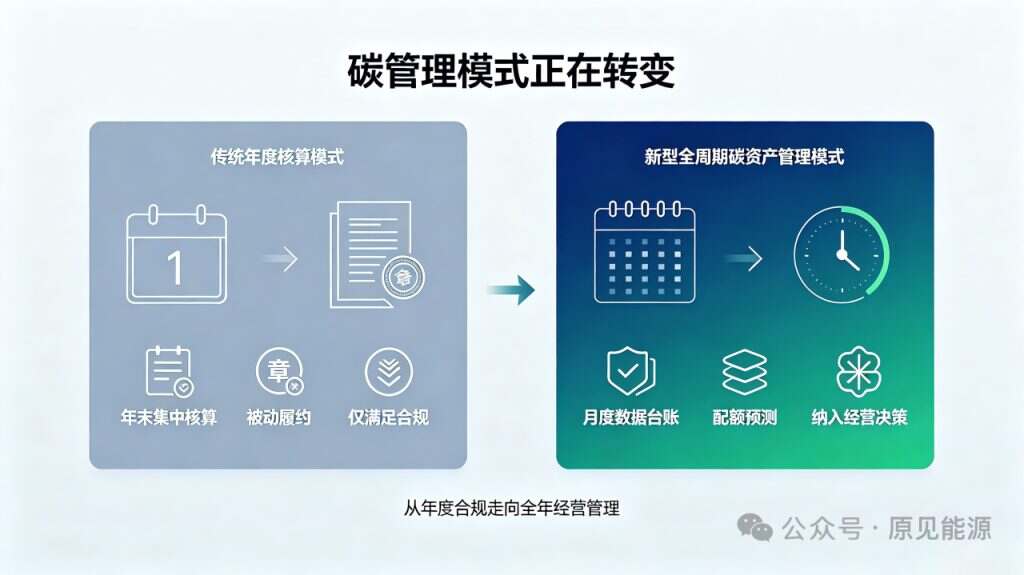
In the past, some enterprises were accustomed to centrally organizing energy consumption, product output, emission factors, purchased electricity, and related supporting materials at the end of the year to complete annual carbon accounting and third-party verification. This method was barely manageable when carbon costs were low and data management requirements were relatively loose.
Currently, however, the national carbon market’s requirements for data quality and process management are increasing. Key industries such as power generation, steel, cement, and aluminum smelting have gradually entered the stage of monthly data archiving and refined management. If enterprises still rely on year-end data patching and manual Excel summaries, three problems are likely to arise.
First, inconsistent data standards.
Production, energy, environmental, and finance departments each hold different data, only to discover inconsistencies during the verification stage.
Second, incomplete process records.
When anomalies in energy consumption or product output occur in a specific month, it is impossible to quickly trace the cause or provide complete supporting documentation.
Third, lack of predictive capability.
Enterprises that only discover a quota deficit at the end of the year often miss better trading windows and opportunities for emission reduction adjustments.
Therefore, for steel and cement enterprises, what truly needs to be established is not a “year-end accounting mechanism,” but a continuously operating monthly carbon data management mechanism.
II. The Focus of Carbon Management Should Shift from “Accounting Results” to “Operational Forecasting”
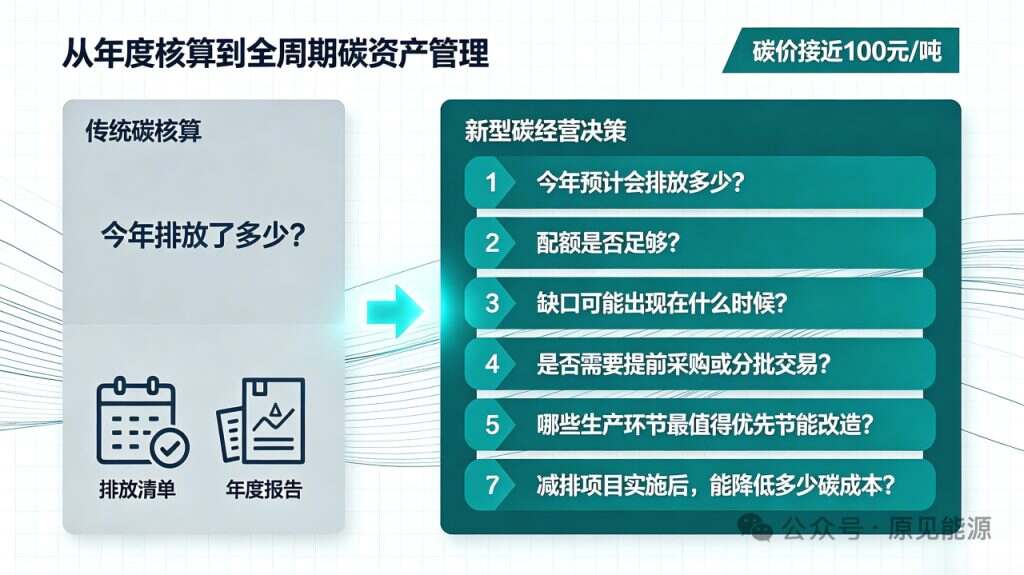
Traditional carbon accounting focuses on: How much did we emit this year?
However, with carbon prices near 100 RMB/ton and quota management becoming increasingly refined, enterprises need to answer the following:
How much are we expected to emit this year?
Are the allowances sufficient?
When is a deficit likely to occur?
Is there a need for advance procurement or batch trading?
Which production stages deserve priority for energy-saving retrofits?
How much can carbon costs be reduced after implementing emission reduction projects?
This is the shift from “carbon accounting” to “carbon asset management.”
For steel enterprises, energy structures and emission intensities vary across stages like sintering, ironmaking, steelmaking, and steel rolling. If an enterprise only performs total annual accounting, it is difficult to identify where the true high-energy-consuming and high-emission nodes are. Conversely, by tracking by month, process, and energy type, anomalies can be detected earlier, and retrofit priorities can be determined more accurately.
For cement enterprises, clinker production is the core of emissions. Fuel substitution, waste heat power generation, grinding system optimization, and energy efficiency improvements all affect final emission intensity and allowance surplus or deficit. Without continuous and reliable data, it is difficult for enterprises to judge which retrofit offers the most economic value or to truly integrate energy-saving projects with carbon asset management.
III. As Carbon Prices Rise, the ROI of Energy-Saving Retrofits Needs to Be Recalculated
In the past, when enterprises evaluated energy-saving retrofit projects, they mainly looked at coal consumption, electricity consumption, steam costs, equipment efficiency, and maintenance costs. Now, carbon costs must also be included in the return on investment calculation.
For example, if an energy-saving project reduces CO2 emissions by 10,000 tons annually, with carbon prices near 100 RMB/ton, the improvement in carbon costs alone could generate an annual value of approximately one million RMB. When combined with reduced energy expenses, improved equipment efficiency, extended equipment life, and optimized O costs, the project’s comprehensive ROI becomes much more attractive than in the past.
This is crucial for corporate decision-making.
Because some energy-saving projects previously seemed to have long payback periods, enterprises were not necessarily willing to invest immediately. However, once carbon costs are factored in, the true economic value of the project may be re-evaluated. Therefore, when evaluating energy-saving equipment, waste heat recovery, energy management systems, and energy-carbon data platforms, steel and cement enterprises should not just look at a single energy-saving rate, but should establish a comprehensive ROI model of “energy cost + carbon cost + O cost + compliance risk.”
This is also key to whether future energy-saving and carbon-reduction projects can gain management support.
IV. Three Capabilities Enterprises Should Prioritize Establishing Now
Faced with an increasingly mature carbon market, key emission-controlled enterprises can start with three aspects.
First, establish a monthly carbon data ledger.
Enterprises should collect energy consumption, product output, emission factors, purchased electricity, key process operation data, and supporting materials on a monthly basis to reduce the pressure of year-end centralized organization. The more standardized the monthly data, the more proactive the annual verification will be.
Second, establish a quota surplus/deficit forecasting mechanism.
Enterprises should forecast annual emissions and quota deficits at least quarterly and, combined with carbon price trends, formulate trading, compliance, and emission reduction arrangements. The value of carbon asset management lies in transforming uncertain compliance risks into manageable operational plans in advance.
Third, integrate energy-saving retrofits into carbon asset management.
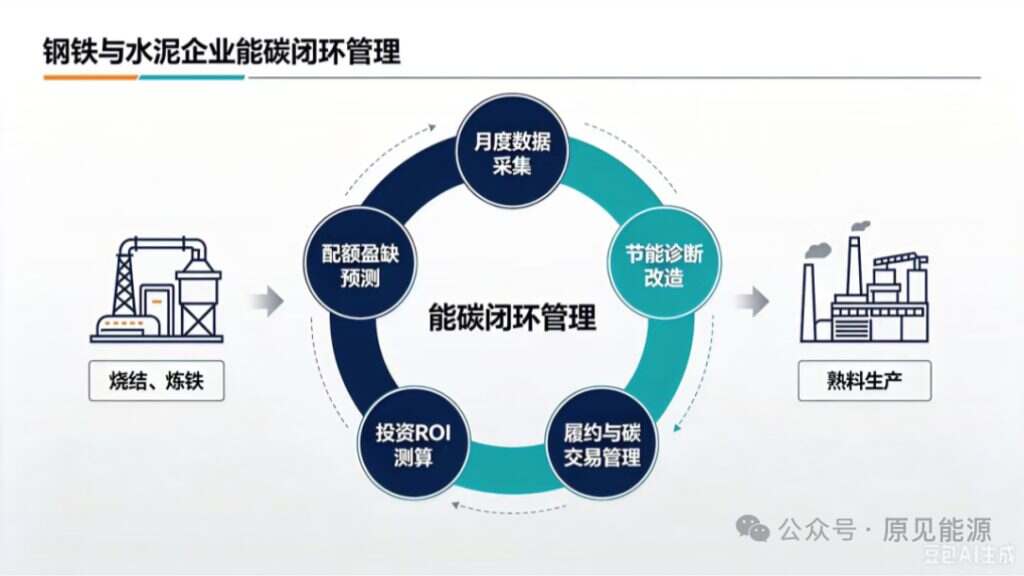
Energy-saving equipment, waste heat recovery, energy management systems, and energy-carbon data platforms should not be viewed as independent procurement projects, but should be integrated into the enterprise’s overall carbon asset management plan. Only by forming a closed loop of “data collection—emission forecasting—energy-saving diagnosis—project retrofit—compliance management” can enterprises truly transform policy pressure into operational gains.
Conclusion
Carbon prices approaching 100 RMB/ton signify that carbon management is moving from compliance work toward operational management.
For key emission-controlled enterprises such as steel and cement, future competitiveness depends not only on the ability to complete annual accounting but also on the ability to establish a continuous, accurate, and traceable data system and integrate carbon costs into production operations and investment decisions.
Truly mature carbon management should achieve: monthly data, quarterly forecasts, annual strategies, project returns, and proactive compliance. The carbon market is entering a more refined stage of development. Enterprises that establish systematic carbon asset management capabilities earlier will have a better chance of taking the initiative amidst future carbon price fluctuations, quota constraints, and green trade rules.