-2.png)



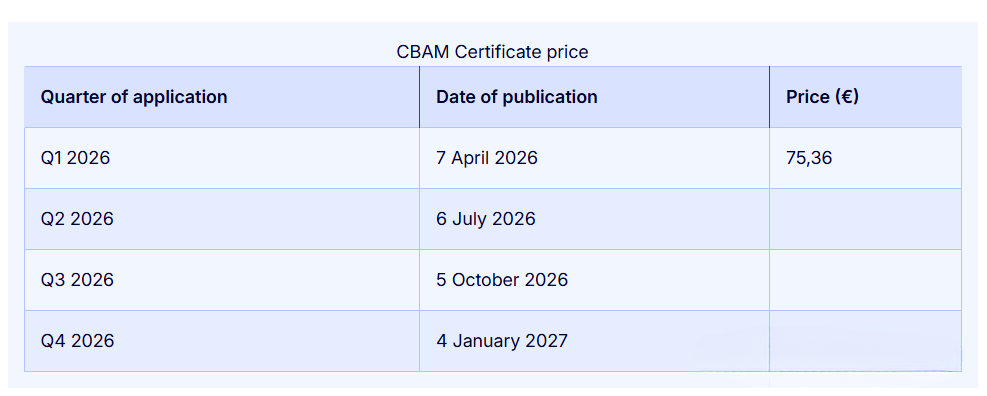
On April 7, 2026, the European Commission officially announced: The CBAM certificate price for the first quarter of 2026 is €75.36 / tonne CO₂e, marking the formal transition of CBAM from the transitional reporting period to the full implementation phase of actual settlement and quarterly pricing.
For enterprises in industries such as steel, aluminum, cement, fertilizer, electricity, and hydrogen exporting to the EU, this means: For every tonne of carbon emitted, payment must be made according to this price.
(Exemption Threshold: Importers with an annual import volume of CBAM goods below 50 tonnes in sectors such as steel, aluminum, fertilizers, and cement are exempt from reporting, declaration, and certificate surrender obligations.)
01 How to Calculate CBAM Carbon Costs
Actual CBAM Fee = (Embedded carbon emissions of the product – Recognized carbon costs already paid) × Current CBAM certificate price.
The report “EU Carbon Border Adjustment Mechanism (CBAM) Policy Progress and Outlook” published by the Institute for Geopolitics and Development Policy (iGDP) points out that currently, China’s national carbon emission trading market has not yet established a total cap constraint mechanism, and the proportion of paid allowances is relatively low. Based on this, the EU may temporarily not recognize the compliance costs of Chinese enterprises for CBAM fee deductions.
This means that Chinese enterprises exporting to the EU must bear both domestic carbon market compliance costs and pay the full EU CBAM fees, resulting in a factual “double carbon cost.”
Simplified Calculation Example:
Assuming the default emission value for a certain steel product is 1.5 tonnes CO₂/tonne of product, without considering free allocations or domestic carbon price deductions:
Carbon Cost = 1.5 tonnes × €75.36 ≈ €113/tonne (approx. 880 RMB)
If an enterprise exports 10,000 tonnes to the EU annually, the annual carbon cost would be approximately €1.13 million (8.8 million RMB).
02 Purchase and Surrender of CBAM Certificates
2.1 When do enterprises start buying certificates?
According to CBAM implementation rules, although the collection of CBAM fees officially started on January 1, 2026, enterprises do not need to purchase certificates immediately. The actual start date for purchasing certificates is February 1, 2027, at which time importers can log in to the EU CBAM Central Platform to complete certificate procurement. It should be noted that the deadline for the first annual surrender is September 30, 2027. While completing the surrender, importers must also simultaneously submit all declaration materials for the year 2026; both must be completed together and are indispensable.
2.2 Enterprise Surrender Process
The surrender process should proceed in the following five steps to ensure compliant fulfillment:
1. Obtain Authorized Declarant Status:
Importers must complete registration in the CBAM AMM system to obtain “Authorized Declarant” status, which is a mandatory prerequisite for importing goods within the scope of CBAM control. Specifically, except for electricity and hydrogen categories, importers with annual imported carbon emissions exceeding 50 tonnes must obtain this qualification; otherwise, they cannot conduct related import business.
2. Collect Supply Chain Carbon Emission Data:
Importers must proactively request operator emission reports, monitoring plans, third-party verification reports, and other relevant documents from non-EU exporters or producers. Exporters must cooperate by providing verified actual carbon emission data; if measured data cannot be provided, the product’s CN Code must be provided for the importer to calculate using EU default values.
3. Calculate Embedded Carbon Emissions of Products:
Importers must strictly follow the methodology uniformly prescribed by the EU to calculate the total embedded carbon emissions of imported products. Once the calculation is complete, applicable free allocations specified by the EU can be deducted to determine the final carbon emissions subject to the carbon cost.
4. Purchase CBAM Certificates:
Starting February 1, 2027, importers can purchase certificates corresponding to the carbon emissions due through the EU CBAM Central Platform. Certificate prices have clear standards: during 2026, they are calculated based on the average price of the quarter in which the import occurred; from 2027 onwards, they will be adjusted to a weekly average price calculation.
5. Submit Declaration and Surrender:
Before September 30 each year, importers must submit the declaration report for the previous year through the CBAM system and simultaneously complete the surrender of the corresponding number of CBAM certificates, ensuring that the declared data perfectly matches the number of surrendered certificates to avoid non-compliance.
2.3 Certificate Buy-back and Cancellation Mechanism
Official EU regulations state that if an enterprise needs to sell back purchased CBAM certificates, it must submit a formal buy-back application by October 31 each year. If the application is not submitted by the deadline, the European Commission will automatically cancel the certificates purchased in the previous year remaining in the enterprise’s account starting November 1 each year, without any form of financial compensation.
03 Red Line Warning: Are there penalties for non-payment or misreporting?
Yes, and the penalties are extremely severe. The cost of non-compliance is far higher than the carbon cost itself. The specific penalty standards are as follows:
| Violation Type | Core Penalty Standard | Additional Penalties / Consequences |
| Failure to Surrender / Under-surrender of Certificates | 1. Base fine: €100 / tonne CO₂e 2. Requirement to pay the difference in the current certificate price 3. Late payment fee of 0.5‰~1‰ per day (cumulative for overdue periods) | Freezing of CBAM accounts, seizure of goods, prohibition of customs clearance, permanent ban from the EU market |
| Misreporting / Under-reporting of Emissions | A fine of 5 to 10 times the current certificate price based on the under-reported/omitted difference | Invalidation of surrendered certificates, requirement for re-payment, inclusion on the customs priority monitoring list |
| Falsifying Verification Reports / Inflating Carbon Offsets | 1. Base fine: €100,000 to €1,000,000 per instance 2. Additional fine of 5 to 10 times the certificate price for the difference 3. All surrendered certificates invalidated and must be re-paid | Revocation of authorized declarant status, 3 years of strict control, recorded on the EU credit blacklist |
| Failure to Declare / Late Declaration | A fine of 3 to 5 times the current certificate price based on undeclared emissions + daily late fees | Freezing of accounts, suspension of export rights to the EU, restriction of subsequent business |
| Importing Without Qualification / Splitting Orders / Evading Declaration | €300 to €500 / tonne (3 to 5 times the base fine of €100/tonne) | Direct seizure of goods, denial of customs clearance, lifelong priority monitoring |
| Refusal to Cooperate with Verification / Insufficient Data Retention (less than 10 years) | Fines starting from €100,000 per instance | Prohibition of imports, permanent restriction on EU business, downgrade of corporate credit rating |
04 How can enterprises break through?
① Verify product HS codes to confirm whether they are within the scope of CBAM coverage;
② Calculate the carbon cost of products exported this quarter based on the price of €75.36/tonne;
③ Establish an MRV system to complete actual carbon emission measurements and third-party verification to avoid overpaying taxes due to default values;
④ Clarify data sharing responsibilities with EU importers and retain all declaration-related vouchers;
⑤ Implement green electricity, promote clean energy substitution, optimize production processes, improve energy efficiency, actively participate in the domestic carbon market, and obtain deductible carbon credits.
Final Reminder: CBAM has fully entered the substantive implementation phase from the transitional period. €75.36/tonne is just the beginning; subsequent prices will be updated quarterly (anchored to the average quarterly auction price of the EU ETS). For enterprises exporting to the EU, calculating carbon accounts accurately, standardizing declarations, and proactively reducing carbon emissions are the keys to maintaining their position in the EU market.
Conclusion: CBAM is not only a tariff barrier but also a new rule for global green trade. It is reshaping the competitive landscape of the global industrial chain. For Chinese enterprises, the earlier they establish a comprehensive carbon management system, the better they can secure a dual advantage in cost and branding in the future European and global markets.