-2.png)


Introduction
In July 2026, the State Council issued the “Action Plan for Carbon Peak During the 15th Five-Year Plan Period,” clearly setting mandatory targets to reduce carbon emissions per unit of GDP by 17% by 2030 compared to 2025, and to increase the share of non-fossil energy consumption to 25%. Concurrently, the “Dual Control System for Carbon Emissions” was fully implemented during the 15th Five-Year Plan period—carbon emission intensity has replaced energy consumption intensity as a binding indicator. Systems for carbon emission statistics and accounting, carbon footprint management, and comprehensive evaluation and assessment of carbon peaking are being rapidly constructed. Under this policy wave, energy-carbon management platforms have leaped from being “digital tools that are nice to have” to becoming core infrastructure for enterprises, industrial parks, and governments to advance “Dual Carbon” objectives.
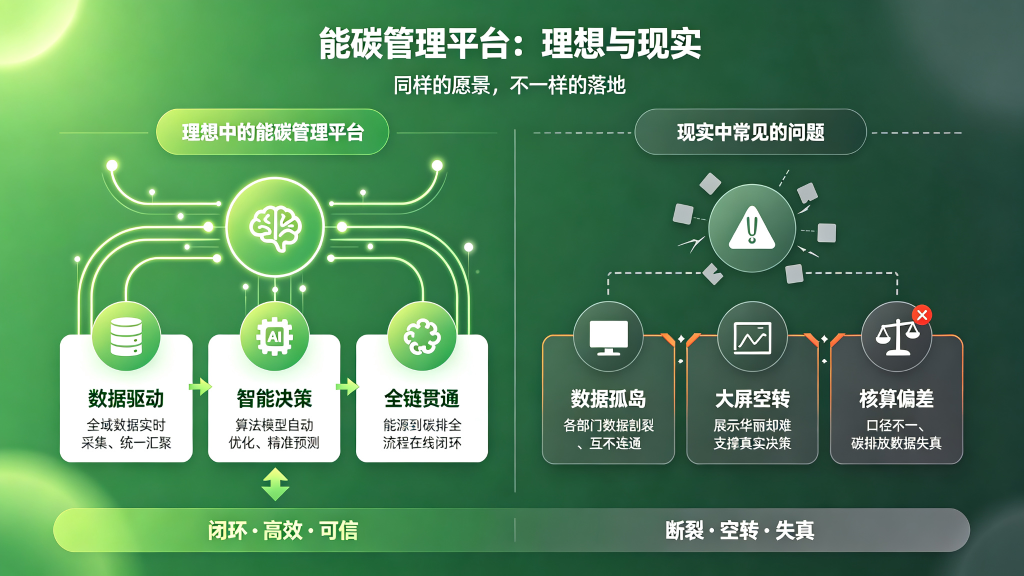
However, extensive practice shows that many energy-carbon management platforms have become mere “large-screen display tools” after going online, characterized by inaccurate data, questionable accounting, and weak decision-making support, failing significantly to deliver their expected value. The reason for this lies precisely in the neglect of the following six key points during the construction process.
Point 1: The “Last Mile” of Data Collection—The Measurement System is the True Foundation
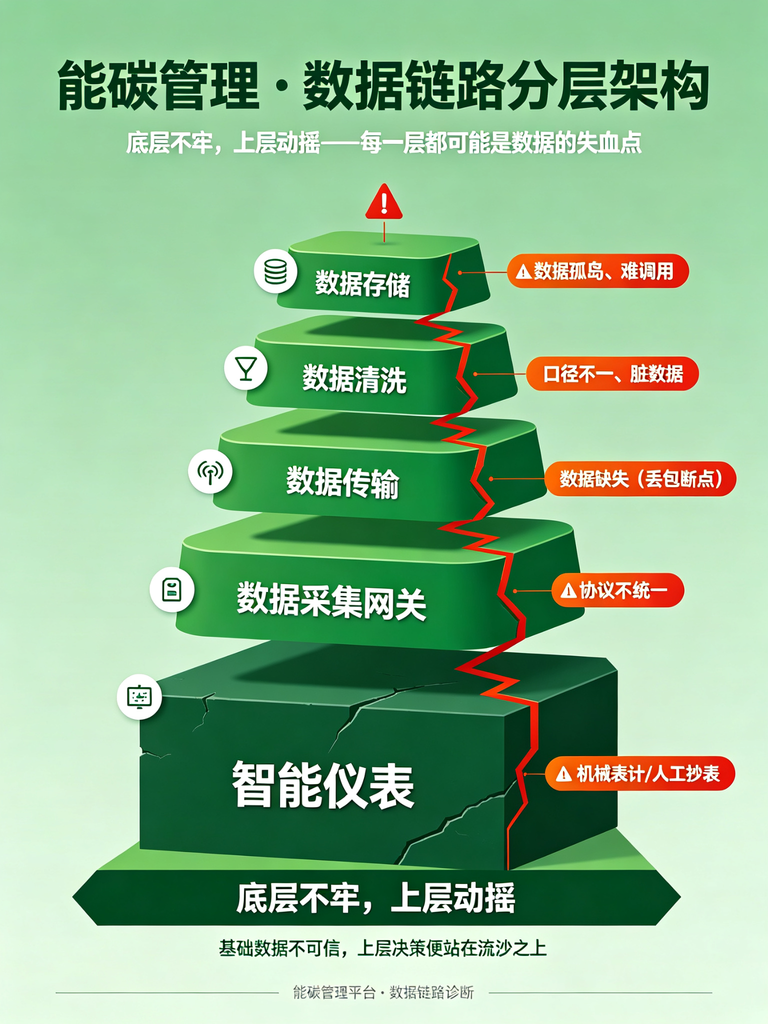
Neglected Manifestation: The vast majority of developers concentrate their budget and energy on platform software development and visual displays, while investment in underlying measurement instruments and data collection networks is severely insufficient.
Core Issue: Many old factories and industrial parks still use traditional mechanical meters and rely on manual reading, resulting in data lags of several days or even weeks. Various energy equipment for water, electricity, steam, and photovoltaic storage use different transmission protocols and data formats, creating “data silos.” Furthermore, collection granularity is coarse; with only total meter data available, it is impossible to drill down to the production line, equipment, or process level.
Deep Impact: Data collection is the lifeline of the platform. If the underlying data is missing, delayed, or biased, then no matter how advanced the algorithms or how flashy the displays are, the calculated carbon emission results will only be “beautiful errors.” The “Action Plan” explicitly requires “improving the carbon emission statistics and accounting system.” In the future, carbon emission data will be directly used for government assessments, carbon market trading, and carbon footprint certification. Data quality has upgraded from an “internal management need” to a “mandatory compliance requirement.”
Solution: Conduct a data maturity diagnosis before construction to map out measurement blind spots across the entire factory or park, and phase in smart meters and data collection gateways. Simultaneously establish a data quality verification mechanism to ensure that every data point is traceable, recalculable, and auditable.
Point 2: Carbon Accounting Cannot Use “One-Size-Fits-All Templates”—Scenario Adaptation is More Important Than Feature Stacking
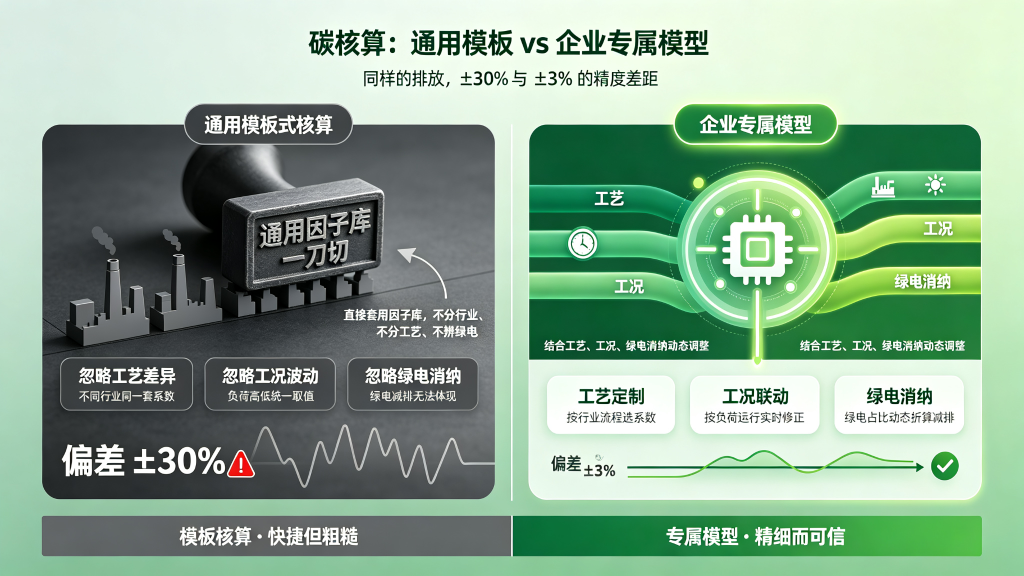
Neglected Manifestation: Many platforms simply overlay carbon accounting modules onto traditional energy management systems and directly apply general industry carbon emission factor libraries. This results in statistical boundaries and calculation scopes that cannot be unified with energy data, leading to vastly different carbon emission results from the same set of energy consumption data.
Core Issue: The complexity of carbon emission accounting far exceeds that of energy statistics. Different industries, processes, and equipment exhibit significantly different carbon emission characteristics under various operating conditions. For example, the emission intensity of a boiler differs completely during full load, low load, and start-stop phases. For the same kilowatt-hour of electricity, the carbon emission factors for grid power, photovoltaic green power, and self-provided units are worlds apart. Ignoring these scenario differences means accounting results can only serve as rough references and cannot meet the precision requirements for carbon market trading, carbon audits, and product carbon footprint certification.
Deeper Issue: During the 15th Five-Year Plan period, the dual control system for carbon emissions will incorporate carbon emission indicators into local government assessments. Corporate carbon emission data will directly affect quota allocation and compliance costs. If accounting results cannot withstand third-party verification, enterprises will face compliance risks and economic losses.
Solution: Platform construction must shift from “general industry models” to “enterprise-specific models.” Accounting parameters should be dynamically adjusted based on the enterprise’s own production processes, fuel types, equipment conditions, and regional power grid carbon emission characteristics. Meanwhile, ensure that accounting formulas, factors, and intermediate processes are traceable, exportable, and recalculable, allowing enterprises to independently maintain basic configurations.
Point 3: System Integration is a “Tough Nut to Crack”—Do Not Connect Only Energy Data While Ignoring Business Data
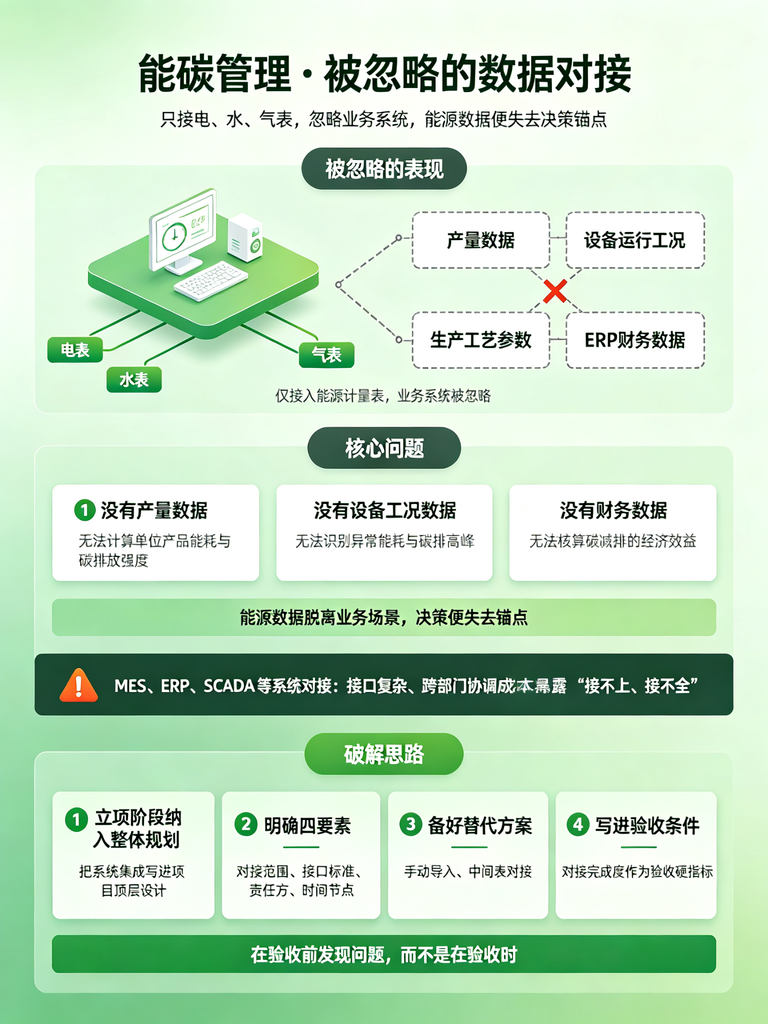
Neglected Manifestation: Many platforms only connect to energy measurement data such as electricity, water, and gas meters, while neglecting integration with business systems like production output data, equipment operating conditions, production process parameters, and ERP financial data.
Core Issue: Without production data, it is impossible to calculate energy consumption and carbon emission intensity per unit of product. Without equipment condition data, abnormal energy consumption and carbon emission peaks cannot be identified. Without financial data, the economic benefits of carbon reduction cannot be calculated. When energy data is detached from business scenarios, it loses its anchor for management decision-making.
Furthermore, data integration between business systems like MES, ERP, and SCADA and the energy-carbon management platform often involves complex interface development and cross-departmental coordination. The technical difficulty and communication costs are often seriously underestimated. Many projects find that key systems “cannot be connected” or are “incompletely connected” only at the time of acceptance.
Solution: Include system integration in the overall planning during the project initiation stage. Define the scope, interface standards, responsible parties, and milestones for data integration with each business system. For systems that cannot be integrated temporarily, develop alternative solutions (such as manual import or intermediate table integration) and clearly include them in the acceptance criteria.
Point 4: Platforms are Not “Turnkey Projects”—Operation and Maintenance Determine Survival
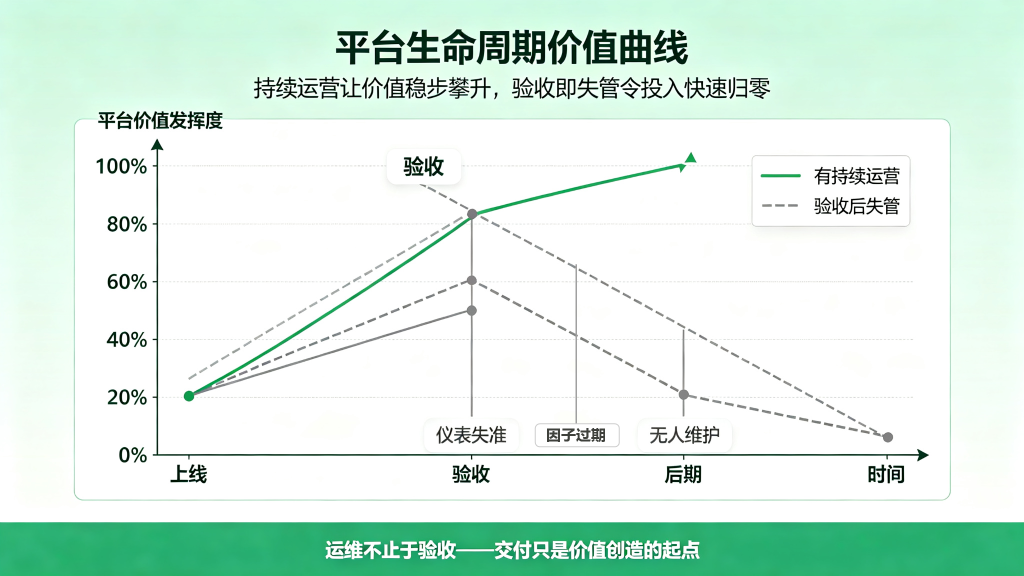
Neglected Manifestation: A large number of energy-carbon management platforms lack dedicated maintenance after acceptance. Data updates stop, algorithm models degrade, and system functions sit idle, eventually turning them into “zombie systems.”
Core Issue: Unlike office automation systems, an energy-carbon management platform is not a static tool built once; it is a management system that requires continuous operation and dynamic iteration. Measurement instruments need regular calibration, accounting factors need to be updated with policies, algorithm models need to be retrained based on production changes, and reports and dashboards need continuous optimization based on management needs. All of these require ongoing human investment and operational budgets.
Solution: Platform construction must be accompanied by an annual operating budget, with clear responsibility mechanisms for instrument calibration, interface maintenance, personnel handovers, and exception handling. Review the actual effectiveness of one scenario every quarter, continuously phase out useless functions, and add capabilities that truly support decision-making. Prevent “abandonment upon acceptance.”
Point 5: Organizational and Talent Gaps—The “Last Mile” Chasm Between Technology and Management
Neglected Manifestation: Platform construction is led by the IT department, but operation and use fall to the energy management or environmental protection departments. This creates a disconnect where users do not know how to use it or do not want to use it, preventing the platform’s value from being realized.
Core Issue: An energy-carbon management platform is essentially a management tool, not a pure technical system. It requires the coordination of energy engineers, carbon managers, data analysts, and frontline operations personnel. However, composite talents who understand energy, carbon, and data simultaneously are extremely scarce in the current market. Enterprises often underestimate the difficulty of talent cultivation and organizational change.
Solution: Launch a talent echelon training plan alongside platform construction, drawing backbone members from energy management, production process, and IT departments to form a “Special Energy-Carbon Management Task Force.” Simultaneously establish a usage assessment mechanism, incorporating indicators such as platform usage frequency, data quality, and exception handling efficiency into the performance evaluations of relevant departments and personnel.
Point 6: From “Dual Control of Energy Consumption” to “Dual Control of Carbon Emissions”—The Policy Logic Has Changed, and Platform Thinking Must Keep Up
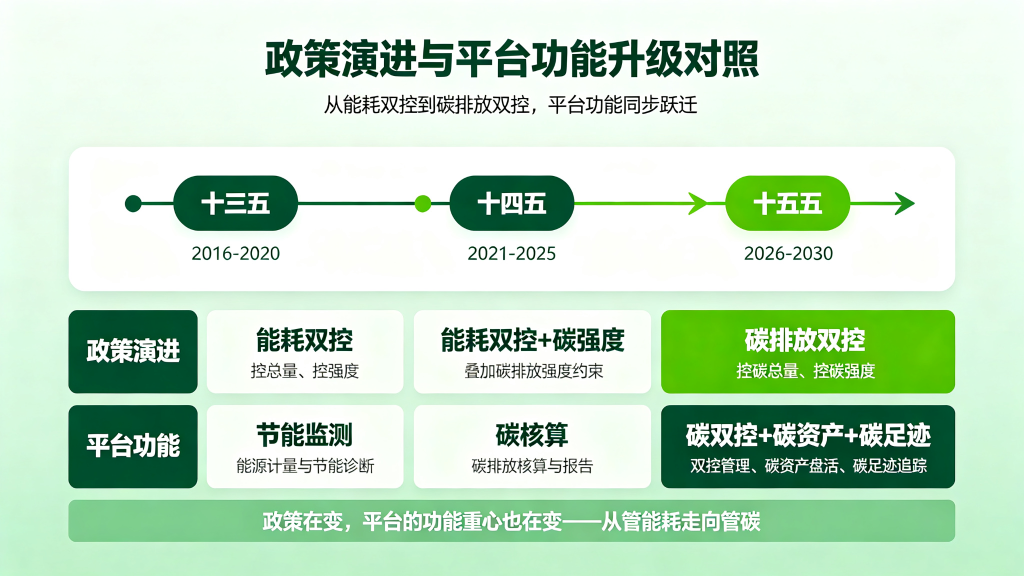
Neglected Manifestation: The design logic of many energy-carbon management platforms remains stuck in the era of “Dual Control of Energy Consumption” prior to the 15th Five-Year Plan, focusing on energy consumption monitoring and energy-saving analysis, with carbon emission management as a mere auxiliary module.
Core Issue: During the 15th Five-Year Plan period, carbon emission intensity has replaced energy consumption intensity as a binding indicator, and total carbon emissions are included in assessments. This means the core function of the platform must shift from “managing energy consumption” to “managing carbon emissions.” Specifically, the platform needs to support new functions such as carbon emission budget management, carbon emission early warning, carbon quota compliance tracking, carbon asset trading assistance, and product carbon footprint accounting. It needs to interface with multiple external systems such as the national carbon emission rights trading market and the green certificate trading market, and meet the data reporting requirements for dual control carbon emission assessments.
Solution: During the platform planning stage, benchmark against the policy requirements of the 15th Five-Year Plan’s dual control of carbon emissions. Reconstruct the platform’s functional architecture with carbon emission management as the main thread to ensure the platform’s “policy adaptability” and “assessment responsiveness.”
Conclusion
Building an energy-carbon management platform is a “war of attrition,” not a “blitzkrieg.” During the critical period of the 15th Five-Year Plan’s carbon peak offensive, the value of a platform lies not in how flashy the displays are or how rich the features are, but in whether the data is authentic and credible, whether the accounting can withstand audits, and whether decisions are truly implemented. Those easily neglected underlying issues—measurement systems, accounting precision, system integration, continuous operation, talent assurance, and policy adaptation—are precisely what determine the success or failure of platform construction. Only by returning to the basics and solidly performing this “invisible work” can the energy-carbon management platform truly become a digital engine for the green and low-carbon transformation of enterprises.