-2.png)


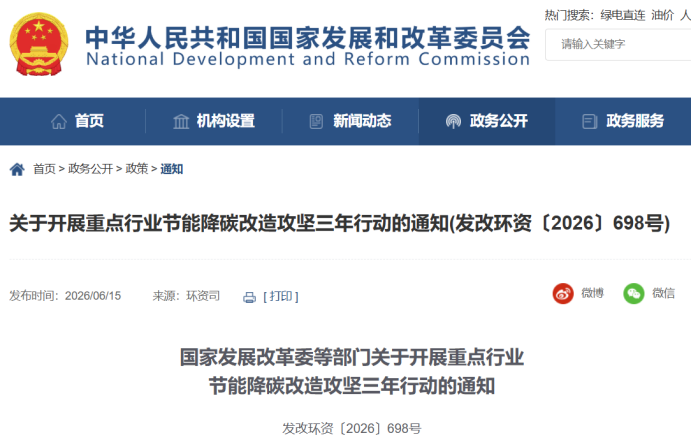
On June 15, five departments including the National Development and Reform Commission recently jointly issued the “Notice on Carrying Out a Three-Year Action for Energy-Saving and Carbon-Reduction Retrofitting in Key Industries” (NDRC Environmental Resources [2026] No. 698, hereinafter referred to as the “Notice”). This initiative strengthens energy-saving and carbon-reduction efforts in key industries. Over the next three years, it will promote comprehensive retrofitting for enterprises in key sectors and enhance overall energy and carbon efficiency levels. This will provide strong support for achieving carbon peak goals, while creating ample space and green momentum for high-quality economic and social development.
I. Main Objectives of the “Notice”
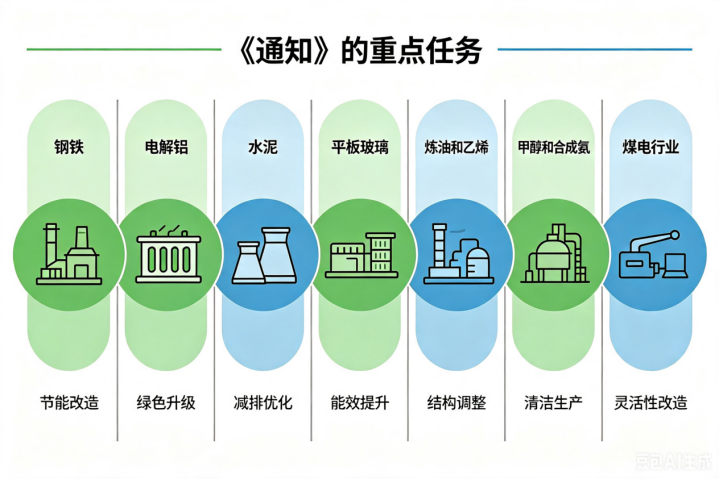
Focusing on nine key industries—steel, electrolytic aluminum, cement, flat glass, oil refining, ethylene, synthetic ammonia, methanol, and coal-fired power—the goal is that by the end of 2028, the proportion of production capacity reaching current energy efficiency benchmarks in the first eight industrial sectors will increase by an average of 20 percentage points. The coal-fired power industry aims for a 15 percentage point increase. Production capacity below the energy efficiency baseline will be essentially eliminated, resulting in a cumulative energy saving of over 100 million tons of standard coal and a reduction of over 200 million tons of CO2 emissions. Starting from 2028, the scope of implementation will be further expanded based on actual conditions, with other industries added in a phased manner; various regions may also take the lead in an orderly fashion based on work requirements.
II. Key Tasks of the “Notice”
(I) Steel Industry
• Promote energy-saving and carbon-reduction retrofitting of key processes and equipment such as blast furnaces and converters; implement upgrades for waste heat recovery and waste energy power generation.
• Apply advanced technologies such as high-proportion pellet smelting in blast furnaces, promote interface connection technologies like “one-ladle-to-the-end” for molten iron, and orderly carry out the application of hydrogen metallurgy technologies.
• Accelerate the renewal and upgrading of energy-using equipment such as motors, fans, boilers, and air compressors.
• Accelerate the retrofitting and upgrading of top-charging coke ovens with a carbonization chamber height of less than 6 meters (stamp-charging coke ovens less than 5.5 meters) and pelletizing equipment with a capacity of less than 1.2 million tons/year.
(II) Electrolytic Aluminum Industry
• Promote energy-saving and carbon-reduction retrofitting of production units such as aluminum electrolytic cells; optimize high-efficiency recovery and cascade utilization systems for flue gas waste heat.
• Promote the application of advanced technologies and equipment such as new steady-flow insulated aluminum electrolytic cells, graphitized cathodes, and high-quality anodes.
• Accelerate the renewal and upgrading of energy-using equipment such as motors, fans, air compressors, and transformers.
• Accelerate the retrofitting and upgrading of pre-baked anode aluminum electrolytic cells below 300kA and independent aluminum carbon projects below 150,000 tons/year.
(III) Cement Industry
• Promote energy-saving and carbon-reduction retrofitting of key processes such as cement clinker production; implement green and low-carbon substitution of raw materials and fuels.
• Promote high-efficiency equipment such as six-stage preheaters and fourth-generation center-roll-breaker high-efficiency grate coolers, as well as process technologies like vertical roller mill final grinding systems and separate grinding.
• Accelerate the renewal and upgrading of energy-using equipment such as motors, fans, air compressors, and transformers.
• Accelerate the retrofitting and upgrading of cement grinding stations with a capacity of less than 600,000 tons/year.
(IV) Flat Glass Industry
• Promote energy-saving and carbon-reduction retrofitting of key units such as glass furnaces; implement clean fuel substitution and improve the level of green electricity application in key processes.
• Promote technologies such as oxy-fuel (oxygen-enriched) combustion and high-efficiency insulation for glass melting furnaces; strengthen the application of high-efficiency low-NOx burners and gradient composite insulation.
• Accelerate the renewal and upgrading of energy-using equipment such as motors, fans, and transformers.
• Accelerate the retrofitting and upgrading of projects using inefficient glass melting furnaces and traditional air-assisted combustion.
(V) Oil Refining and Ethylene Industry
• Promote energy-saving and carbon-reduction retrofitting of core refining processes such as atmospheric and vacuum distillation and catalytic cracking, as well as units for aromatics, olefins, and ethylene glycol; implement waste heat recovery and utilization, green low-carbon substitution of raw materials and fuels, and electrification of energy systems.
• Promote process technologies such as high-efficiency catalytic cracking flue gas turbines and low-carbon deep processing of heavy and inferior residual oil.
• Accelerate the renewal and upgrading of high-efficiency steam, refrigeration/heating, and air compression systems.
• Accelerate the retrofitting and upgrading of units and processes such as atmospheric and vacuum distillation below 10 million tons/year and catalytic cracking below 1.5 million tons/year.
(VI) Methanol and Synthetic Ammonia Industry
• Promote energy-saving and carbon-reduction retrofitting of units such as coal gasifiers and steam reformers; strengthen the efficient utilization of waste heat, residual pressure, and gasifier slag; implement green low-carbon substitution of raw materials and fuels and electrification of energy systems.
• Promote advanced technologies such as water-wall coal-water slurry gasification and low-energy synthesis.
• Accelerate the renewal and upgrading of energy-using equipment such as motors, fans, boilers, compressors, and transformers.
• Accelerate the retrofitting and upgrading of units and processes such as natural gas-to-methanol below 300,000 tons/year and coal-to-methanol below 1 million tons/year.
(VII) Coal-fired Power Industry
• Promote energy-saving and carbon-reduction retrofitting of existing coal-fired power units above 300,000 kW; promote technologies such as flow passage and high-efficiency combustion; accelerate the renewal and upgrading of energy-using equipment such as fans, boilers, and steam turbines.
• Promote the comprehensive retrofitting of high-efficiency regulation capabilities such as fast regulation, deep regulation, and wide-load operation for coal-fired power.
• Promote the implementation of thermal-electric decoupling retrofitting for combined heat and power (CHP) units in winter centralized heating areas according to local conditions.
• Promote the implementation of low-carbon retrofitting for eligible existing coal-fired power units above 300,000 kW.
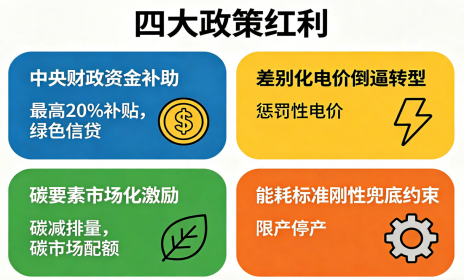
III. Four Major Policy Benefits
① Central Government Financial Subsidies
Eligible energy-saving and carbon-reduction retrofitting projects can receive a subsidy of up to 20% of the total project investment from the central budget. Projects that are the first to reach energy efficiency benchmarks will receive priority approval. This is supported by multiple financial tools including green credit, carbon reduction support tools, and green bonds.
② Differentiated Electricity Pricing to Force Transformation
Punitive electricity prices will be implemented for enterprises that do not meet energy efficiency standards, forcing inefficient enterprises to proactively carry out energy-saving retrofits. The additional electricity fees collected will be specifically used for regional energy optimization and upgrading.
③ Market-Based Incentives for Carbon Elements
Emission reductions generated by technical retrofitting can be used as replacement indicators for energy consumption and carbon emissions. National carbon market allowance surpluses, CCERs, and local certified emission reductions can all be used for corporate compliance, achieving dual benefits in energy saving and carbon reduction.
④ Rigid Bottom-Line Constraints of Energy Consumption Standards
Production lines that fail to complete energy-saving retrofits and still do not meet energy efficiency standards by the end of 2028 will face production limits, suspension, or even closure and exit in accordance with the law.
IV. Practical Implementation Recommendations for Enterprises
1. Quickly survey plant energy consumption and complete energy efficiency self-inspection and diagnosis against industry baselines and benchmarks.
2. Prepare projects for waste heat recovery, process upgrades, and green electricity substitution to seize the application window for central government subsidies.
3. Build a supporting online energy consumption monitoring platform to meet requirements for acceptance, verification, and carbon compliance.
4. Organize a ledger for phasing out backward production capacity to avoid risks of policy-driven shutdowns and fines.
Conclusion
This NDRC Environmental Resources [2026] No. 698 document is a mandatory industrial carbon reduction construction plan that comes with funding, deadlines, and accountability. The core significance of this policy lies in: during the critical period of carbon peaking, using a combination of mandatory targets, market-based incentives, and carbon replacement breakthroughs to transform the largest carbon emission sources in the industrial field from “objects of constraint” into “subjects of transformation,” turning energy saving and carbon reduction from a cost burden for enterprises into a strategic investment for gaining development space.