-2.png)


I. Policy Essence: An Institutional Leap from Dedicated Line Privileges to Inclusive Infrastructure
Document No. 650 established “one-to-one physical dedicated line direct access” for green power, achieving physical traceability through exclusive lines. The core breakthrough of Document No. 688 is allowing one-to-many, park-level, and multi-legal entity direct green power connections, relaxing the traceability method from physical dedicated lines to data traceability based on time-of-use metering + power proportion allocation. This makes it feasible for multiple users to share green power facilities. This is an institutional redistribution of renewable energy consumption space, opening up large-scale consumption space at minimal institutional cost.

II. Underlying Logic: Optimal Path Selection Under a Four-Quadrant Framework
The core contradiction of direct green power connection lies in the asset boundaries and the interface of electricity price regulation, rather than technical issues. Document No. 688’s choice of behind-the-meter social investment + data traceability is the optimal solution that balances efficiency and stability.
| Physical Traceability (Exclusive Dedicated Line) | Data Traceability (Time-of-use Sharing) | |
| Grid Investment Side (Front-of-the-meter Public Assets) | Grid-led direct supply, with costs included in transmission and distribution prices | Not included in the document; flexible guidance for transformation |
| Social Investment Side (Behind-the-meter User Assets) | Document No. 650: Single-user Main Track | Document No. 688: Multi-user Main Track |
Front-of-the-meter involves deep-water reforms such as transmission and distribution prices and distribution operation rights. Behind-the-meter breakthroughs do not affect the core responsibilities of the grid, using data traceability instead of physical exclusivity to gain economies of scale. The reform is pragmatic and faces the least resistance.
III. Three Strategic Risks: Data Traceability is Not a Universal Key
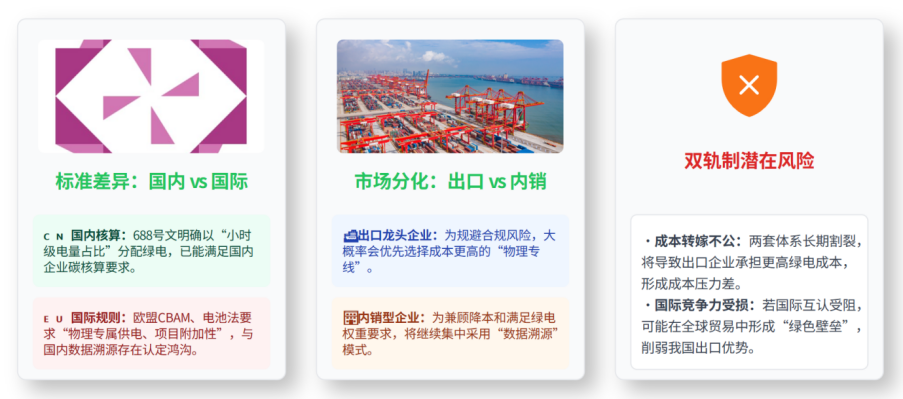
(1) Divergence in Traceability Levels, Falling into the International Carbon Compliance Dual-Track Trap
Data traceability satisfies domestic carbon accounting but differs in recognition from the physical exclusive power supply and additionality required by EU CBAM and battery regulations. Leading export enterprises will continue to choose physical dedicated lines, while domestic-oriented enterprises will concentrate on data traceability, which easily leads to cost unfairness and barriers to international mutual recognition.
(2) Leasing Existing Facilities: Gray Areas in Safety and Liability Supervision
The document allows the leasing of existing power facilities, which helps revitalize assets. However, boundaries such as operation and maintenance entities, fault liability, and grid connection point safety can easily become blurred, leading to disputes in practice.

(3) Mismatched Grid Incentives: Guarding Against Conflicts of Interest Under “Opening a Window While Closing a Door”
Policy guides the grid to shift from a dedicated line asset investor to a traceability certification and platform service provider. However, as the grid plays a dual role in public transmission/distribution and behind-the-meter services, vigilance is needed against cross-subsidization, data barriers, and lack of neutrality.

IV. Carbon Asset Shortcomings: The Electricity-Carbon-Certificate Chains Are Not Yet Integrated
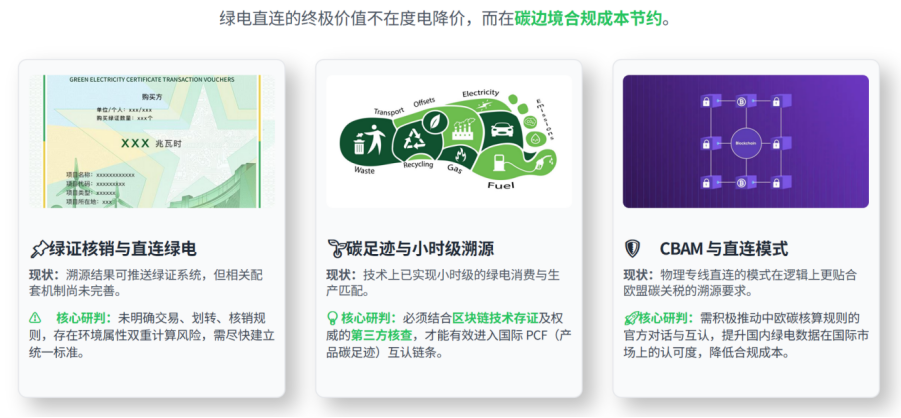
Document No. 688 opens the direct connection channel on the power side, but there are obvious shortcomings in the carbon-side linkage, directly affecting the carbon costs and international competitiveness of export industries. The ultimate value of direct green power connection lies not in the price reduction per kilowatt-hour, but in savings in carbon border compliance costs.
| Integration Dimension | Current Status | Core Assessment |
| GEC Cancellation and Direct Green Power | Traceability results pushed to the GEC system | Trading, transfer, and cancellation rules are not specified, making double counting likely |
| Carbon Footprint and Hourly Traceability | Achieving hourly matching | Requires blockchain evidence storage and third-party verification for international mutual recognition |
| CBAM and Direct Connection Models | Physical dedicated lines align better with EU logic | Data traceability requires promoting the alignment of China-EU rules |
V. Comprehensive Evaluation and Historical Positioning
| Evaluation Dimension | Star Rating | Core Judgment |
| Potential for Consumption and Efficiency Enhancement | ★★★★☆ | Opens up consumption space in industrial parks; rigid indicators are yet to be implemented |
| Institutional Friction Control | ★★★★★ | Behind-the-meter breakthroughs; lowest reform cost |
| International Carbon Compliance Support | ★★★☆☆ | Data ensures scale; physical lines ensure CBAM requirements |
| Grid Interest Coordination | ★★★☆☆ | Clever strategy; long-term rule anchoring is required |
| Carbon Asset System Integration | ★★☆☆☆ | The shortest plank; detailed rules for the integration of the three chains are urgently needed |
Document No. 688 marks the upgrade of direct green power connection from a demonstrative privilege to replicable infrastructure. However, trading physical exclusivity for scale through data traceability also lowers traceability certainty from “engineering-grade” to “institutional-grade.” Subsequent efforts must accelerate reinforcement in carbon certification, international mutual recognition, and GEC integration.
VI. Policy Recommendations
1. Issue detailed rules for the cancellation, trading, and transfer of GECs for direct green power to prevent double counting of environmental attributes;
2. Build a system of hourly traceability + blockchain evidence storage + third-party verification to align with international carbon footprints;
3. Formulate safety and liability standard agreements for industrial park direct connections to clarify rights and responsibilities in existing leasing scenarios;
4. Establish neutrality supervision rules for grid platform services to prevent cross-subsidization and data monopolies;
5. Retain physical dedicated line channels to form a complementary pattern of data traceability and physical traceability.
The core competitiveness of future direct green power connections lies in the ability to integrate the traceability chain, carbon accounting chain, and GEC chain. This is also the core direction of our energy strategy and carbon asset research.
News link for NDRC Energy Document No. 688:
https://www.ndrc.gov.cn/xxgk/zcfb/tz/202605/t20260520_1405313.html