-2.png)


Introduction:
In thermal power production systems, the conversion and flow of energy form the fundamental infrastructure of industrial operations. However, at the microscopic level of this complex system, the operating status of valves is not merely a control node for fluid paths, but a core variable determining unit thermal efficiency and carbon emission intensity. The performance evolution of these industrial components not only affects the stability of the thermal cycle but also profoundly alters the logical relationship between equipment operation and maintenance (O) precision and a company’s carbon footprint performance.
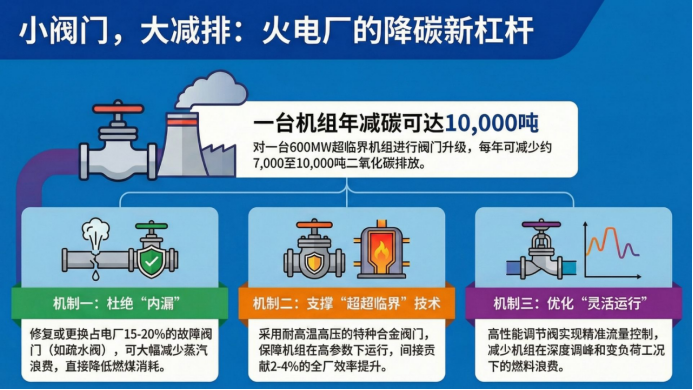
I. Safeguarding Thermal Integrity: Eliminating “Invisible Loss”
Under the rigorous operating conditions of a thermal cycle, internal valve leakage represents more than just the escape of heat; it is a senseless loss of ordered energy. When high-parameter steam quietly flows to the low-pressure end through microscopic seal pores, work capacity is lost and coal consumption intensity increases.
Eliminating this unintended loss caused by hardware performance is not only an inherent requirement for thermal power production systems to address the pressure of dual control on carbon emissions, but it has also become the logical starting point for reshaping energy efficiency benchmarks and asset premiums.
II. Empirical Evidence: Carbon Reduction Calculations for 600MW Units
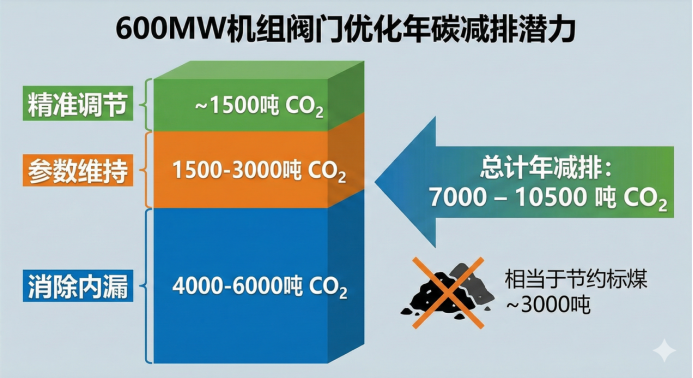
We calculate the impact of valve performance on carbon emissions based on data. Using the EPRI (Electric Power Research Institute) TR-109546 Heat Rate Improvement Guidelines and GB/T 2589 General Rules for Calculation of the Comprehensive Energy Consumption, combined with a standard thermal model for a 600MW unit: annual operating hours: 5,000 hours (typical utilization hours), annual power generation: 3 billion kWh. According to carbon emission factors, 1 ton of standard coal equals approximately 2.6 tons of carbon.
By upgrading the performance of valves in key areas, a typical 600MW unit has an annual emission reduction potential of up to 7,000 to 10,500 tons of CO₂:
- Leakage Interruption: Relying on high-specification sealing technology to lock the thermal energy cycle path. Annual emission reduction potential: 4,000 – 6,000 tons.
- Parameter Stability: Ensuring the system remains within optimal design parameter ranges for the long term, reducing operating condition deviations. Annual emission reduction potential: 1,500 – 3,000 tons.
- Precision Modulation: Improving the sensitivity of control feedback and reducing ineffective energy consumption caused by load fluctuations. Annual emission reduction potential: approx. 1,500 tons.
The value of high-performance valves lies in the certainty they maintain even after tens of thousands of opening and closing cycles. The industrial supplies provided by ORISEEN, including isolation valves, control valves, high-performance fire-resistant oils, and lubricants, are also designed to align with the lean energy efficiency paradigms of future energy trends.
From physical equipment selection to precise carbon emission monitoring via CEMS systems, we are committed to making every piece of hardware a reliable pivot for carbon reduction. As the carbon trading market matures, this protection of industrial consistency is being transformed into tangible quota dividends on corporate asset lists.
III. Facilitating Value Reconstruction for Energy Enterprises
Entering 2026, carbon quotas have evolved from a single environmental assessment metric into a core asset attribute for enterprises. This dimensional shift has reshaped market profit and loss logic and become an internal driving force for the deep transformation of the energy industry. The synergy between high-performance hardware facilities and carbon asset management systems essentially drives the power industry to make a structural leap from “compliance-based O” to “efficiency-driven profitability.” Technical interventions focusing on microscopic industrial details not only strengthen the precision of energy utilization but also enhance a company’s core viability within the green access system through efficiency value-added mechanisms.
Conclusion:
Precision defines the landscape; rigor shapes the future.
ORISEEN, exploring green optimal solutions in the industrial field with you.